
DOOH audience measurement for outdoor advertising
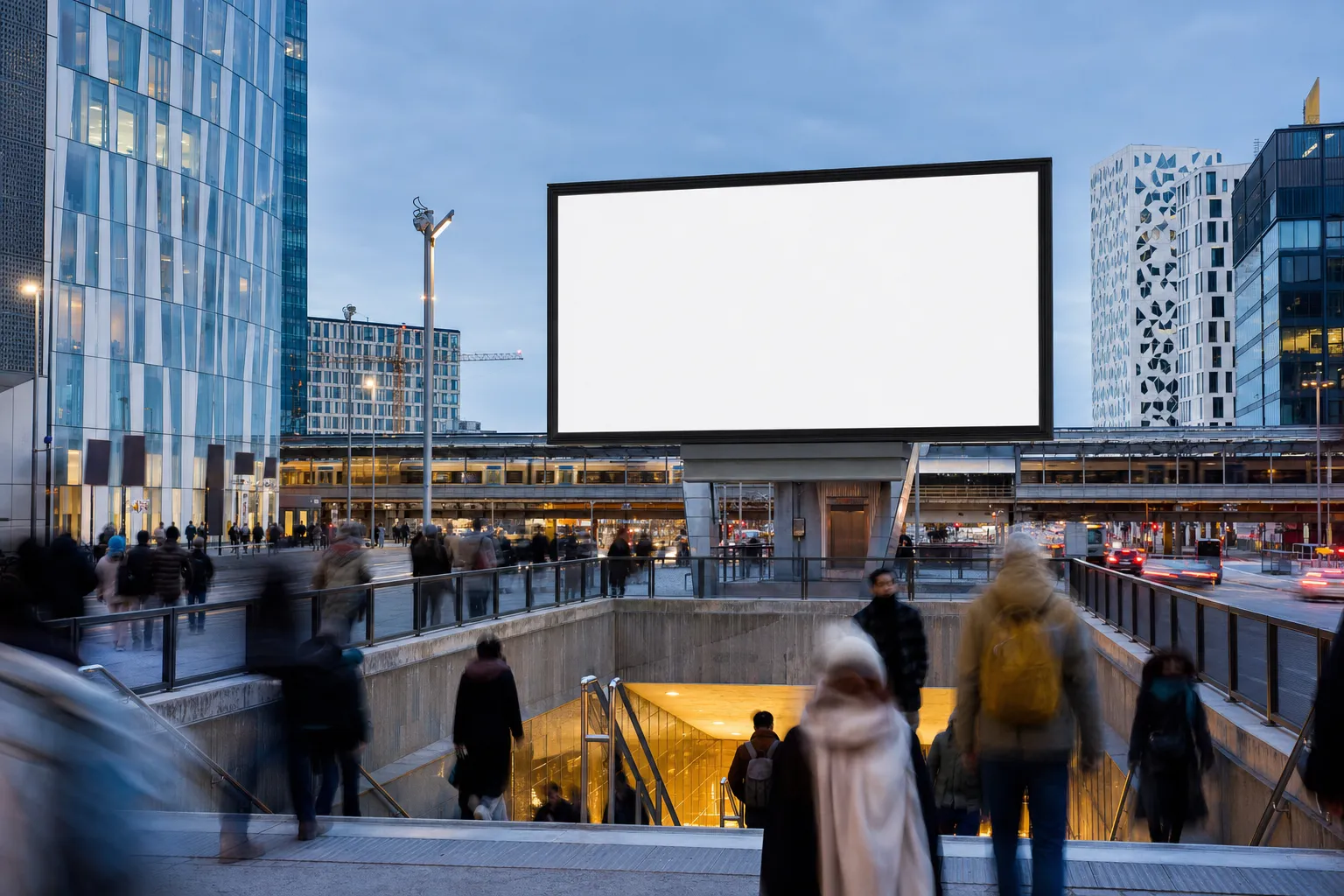
DOOH audience measurement counts impressions, reach within the day and exposure-minutes for each screen and slot. Rate cards built on modelled estimates cost media owners money. With a counted audience, each placement can be sold on the same impression and reach metrics as online advertising.
Real exposure at billboards, screens and anchor points, privacy-first.
Trusted by









Why media owners choose Bumbee Labs
-
Impressions you can prove
Total exposures, reach within the day and accumulated exposure-minutes per screen and slot give you the measured audience the OOH industry trades on, in place of modelled estimates.
-
Sold like online media
Price placements on impressions, reach and CPM, the units digital buyers plan with, and feed measured audiences into programmatic deals.
-
Audience data that is clean to sell
Anonymous, aggregated audience data, approved by a data protection authority.
How it works
-
Measure
Wi-Fi-based footfall around each placement (billboards, screens and anchor points), indoors or out.
-
Process
The anonymous data runs through Bumbee Labs' statistical engine, where reach and impressions are computed.
-
Deliver
Dashboards and exportable campaign reports for advertisers, plus API access.
What data you get
The exposure metrics the OOH industry trades on, derived from real footfall.
- Total exposures the total exposures a screen or message receives in a chosen period
- Unique exposures (reach) within a day, with repeat views by the same individuals filtered out
- Reach and frequency across a campaign of several days, and return visits, with visitor opt-in
- Accumulated exposure-minutes (impressions) the total time the message is seen
- Dwell time how long people stay near the screen on average
- Variations and patterns in exposure by hour, day, week and season, used to optimise slot length and messaging and to price slots differently across the day
- Location ranking placements compared by real audience
On this page
DOOH audience measurement, also called DOOH analytics, counts the audience, impressions and dwell time of each digital out-of-home screen and slot. Wi-Fi counts people indoors and in semi-outdoor places, and mobile network data covers wide outdoor areas. Bumbee Labs is the company behind the only footfall method in Europe approved by a data protection authority.
The short version
- Per screen and slot: impressions, reach within the day, exposure-minutes and dwell time, by hour, day and season.
- Reach and frequency across several days need visitor opt-in.
- Wi-Fi covers indoor and semi-outdoor places; mobile network data covers wide outdoor areas.
- Below: six media-owner questions, ten more, and a Stockholm mall case.
What should DOOH analytics let a media owner defend on the rate card?
Why should the advertiser believe the audience on our rate card?
An advertiser believes a rate card when its audience was counted at the location, because modelled figures don’t hold up when an advertiser questions them. The people around each DOOH screen and slot are counted hour by hour on Wi-Fi indoors and per day from mobile network data outdoors, and impressions and exposure-minutes follow from those counts.
Which of our screens earn a premium, and which should go?
Rank every placement on its real audience: footfall, exposure-minutes and reach within the day. Roadside boards, station screens and mall displays get the same measures, so one yardstick across the portfolio shows which placements are strongest. Benchmarking footfall explains the comparison.
How does DOOH measurement report a campaign and price the day?
What did the campaign deliver, and can we show it halfway through the flight?
The campaign report shows the impressions and exposure-minutes each screen and slot delivered, per day, with the cost per exposure and per exposure-minute. The advertiser gets it through the dashboards and API at the end of the flight or halfway through, in time to adjust. Reach across several days of the campaign needs visitor opt-in.
Should the morning rush cost more than the afternoon?
The audience at a screen swings with the hour, the weekday and the season, and hourly counts show that pattern slot by slot. With them, a media owner can set one price for the morning rush and another for the afternoon, and tune slot length and messaging to match. The counts arrive as data deliverables.
How do agencies and advertisers come to trust the DOOH audience?
Our rate card rests on an old count. What if the flow has changed since?
A rate card built on an outdated traffic model carries that error into every price. Counted at the screen hour by hour, the audience figures pick up a change in the flow, so the numbers behind the card can be refreshed from current counts. Wi-Fi people counting delivers them for indoor and semi-outdoor placements.
The media agency wants a number that is not just ours. What can we hand over?
Hand over a measurement both sides can read. The audience around each screen and slot is counted hour by hour, the same way for seller and buyer, as a visitor count with one definition. Buyers can check modelled numbers against it, so nobody has to argue over whose estimate is right.
How does DOOH audience measurement turn footfall into impressions and CPM?
Measured passage at a screen becomes unique exposures (reach) once repeat passes within the day are filtered out, and accumulated exposure-minutes once time near the screen counts. CPM is media cost divided by impressions, times one thousand, online and out of home alike, and with measured footfall as the input it rests on a counted audience instead of modelled traffic. How DOOH metrics are calculated defines each term.
Can the same measures cover every OOH format in a mixed portfolio?
The industry names its formats by where the audience is: roadside billboards, street furniture such as bus shelters, transit screens in stations and interchanges and airports, and place-based and retail media screens inside shopping centres. Every format gets the same measures, as the audience around the placement counted anonymously, so location rankings and cross-format comparisons hold up in a mixed portfolio. Inside venues, the same measures turn screens and event spaces into priced, measurable inventory.
Which other DOOH measurement questions can the audience count answer?
- Did the campaign move people to the shop? Only in aggregate: footfall at the destination before, during and after the campaign, set against a baseline for weekday rhythm and season, shows whether visits rose. Nobody is followed from the screen to the door, and the method is the one used to measure event impact.
- How do your numbers relate to the industry audience currency? In several markets, advertisers, agencies and media owners trade out of home on an agreed national audience currency; in the UK that is Route, the joint industry currency for out of home. Each one still rests on an estimate of how many people were at the location, and footfall measured at the screen, hour by hour, lets buyers check modelled numbers against it.
- Do our impressions hold up in programmatic buys? A growing share of DOOH inventory is bought programmatically and priced per impression, with the impressions produced by applying a multiplier to each play. Applied to measured footfall, the multiplier gives counts that stand up when buyers further down the chain check them. Dashboards and API access deliver that audience input.
- A commuter passes five times a week: is that five or one? Within a single day, repeat passes are filtered out and count as one unique exposure, without any opt-in. Across several days, telling a returning commuter from a new passer-by needs visitor opt-in; with it, the commuter is one reach unit with a frequency of five.
- But did anyone look? An impression in DOOH is a potential exposure, a person with a plausible opportunity to see a play, counted as an aggregate around the screen; online it is an ad served and logged. Footfall and dwell time do not show how many looked, and attention measurement is a separate category.
- Should we charge more during the Christmas market or the match? An event can multiply the audience at a screen well beyond its baseline, and time-stamped counts show when the spike came and how large it was, which also gives the event renter a report on impact.
- Our board stands by the motorway. Who passes it? Mobile network data counts presence in an area, so one method covers pedestrians, cyclists, motorists and transit passengers, with nothing installed at the board. For the road itself, see traffic counting.
- Where should the next screen go? Mobile network data shows the catchment at a location before anything is built, with nothing installed there. Site selection analysis covers the method.
- How long should the loop be? How much of the loop an audience has time to see depends on dwell time: minutes on a metro platform make a different proposition from seconds in a corridor, at the same footfall. Dwell time per screen guides slot length.
- Is the audience data clean enough to sell? It is anonymous and aggregated, so there is nothing personal in what a media owner sells or reports.
What did a Stockholm shopping mall gain from pricing its screens on measured exposure?
A flagship Stockholm shopping mall used Bumbee Labs footfall data to price screens and event spaces on real exposure, with different rates by day and time. Both its rates and tenant satisfaction improved. Read the shopping mall case →
Curious what this looks like for your venue?

Approved and validated
Measurement is anonymous and aggregated, and no personal data is produced. Bumbee Labs is the company behind the only footfall method in Europe approved by a data protection authority. The measurement is validated by academia and customers, so the numbers can go on a rate card.
By partnering with Bumbee Labs we have opened the door for our end-customers to radically change the way they plan and prepare for the future. They can look to attract more visitors and reform their offer to tailor it to the wants and needs of individuals in and around their sites. This can all be achieved without any additional investment in physical hardware thereby reducing costs, while bolstering their return on investment.
Frequently asked questions
What does DOOH audience measurement count for a screen, and how does it differ from modelled OOH estimates?
It measures the real audience around each placement instead of estimating it. You get total exposures, unique exposures (reach) within a day, accumulated exposure-minutes (impressions) and average dwell time near the screen, plus how these vary by time of day, day and season, in numbers you can defend on a rate card. Reach and frequency across a campaign of several days need visitor opt-in.
Can we sell DOOH on reach and frequency, like online campaigns?
Yes. Impressions and reach within a day come straight from the measurement. Reach and frequency across a campaign of several days require visitor opt-in, because telling a returning visitor from a new one over several days depends on it.
Can we price DOOH slots differently through the day?
Yes. Exposure varies sharply by hour, day and season, and once you can see the pattern you can set your own price for each day-part.
Can we calculate the ROI of a DOOH campaign?
Yes. With real exposure data you can calculate cost per exposure and per exposure-minute, at the end of a campaign or halfway through, and give advertisers readable reports they can use to adjust mid-flight.
Is DOOH audience data compliant to use commercially?
Yes. The data is anonymous and aggregated, with a data protection authority's approval, so there is nothing personal in what you sell or report.
Does DOOH audience measurement work for programmatic DOOH (pDOOH)?
Yes. Programmatic buys are priced per impression, and those impressions are only as credible as the audience data behind them. Measured footfall per screen gives programmatic deals that audience input, delivered through dashboards and API access.
Where this fits
Part of
In this section
Metrics
Platform and integrations
Data protection:GDPR-compliant footfall analyticsThe IMY decisionGDPR-compliant vs approved