
Your flagship is a brand statement, measure whether it lands
A flagship store carries the brand. It lives on a prime street, the window is a campaign, the floor is an experience. But is the window pulling passers-by inside? Where do visitors actually go and linger? Footfall analytics tell you, store by store, what your sales figures can't.
Street-to-store capture, privacy-first, no personal data.
Trusted by









What you get for your flagship
-
Turn the street into entries
See how many passers-by the storefront and window pull inside, and whether that share moves when the display changes.
-
See where the floor works
Hot and cold zones and dwell time show where visitors linger and what a campaign table, feature wall or brand installation does to traffic.
-
Anonymous from the street in
Privacy-first by design and approved by a data protection authority, so the brand carries no surveillance story.
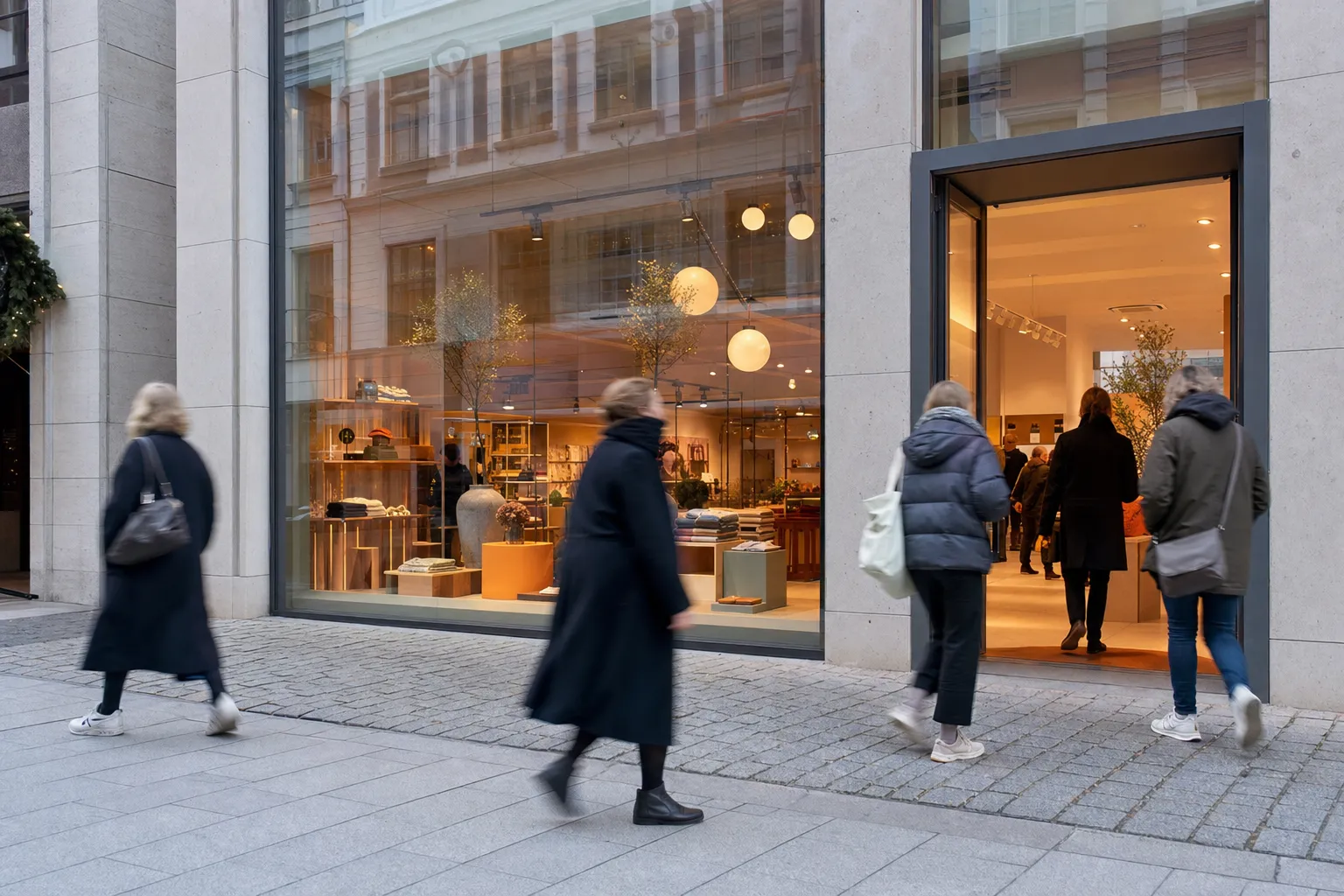
The job to be done
You run a single, high-profile branded store, not a network of lookalike outlets, but a flagship that has to perform commercially and express the brand. The questions are about this store, in detail: How many people pass the storefront, and how many does the window actually pull inside? Does a new window display or façade change move that capture rate? Once people are in, where do they go, where do they dwell, and which zones get ignored? Does the campaign table at the front do its job? Are staff in the right place at the right time for how visitors really flow? Did the launch event, the pop-up or the seasonal install lift footfall and dwell, or just sales? Your sales report tells you the result. It can’t tell you what the street, the window and the floor are doing to produce it.
Street-to-store measurement for one statement store
The access points already serving your shoppers’ phones become the sensor: typically the Wi-Fi you already run, sometimes one or two added to reach the frontage or a specific zone. The priority for a landmark store is the street and the window, so it counts the passers-by outside and the share the storefront converts into entries, then follows visitor counting and dwell across the floor, all processed through a statistical engine and delivered to a dashboard or your own BI. It is also the only footfall method in Europe approved by a data protection authority, so the brand can measure its flagship without any privacy exposure.
How Wi-Fi people counting works →
What data you get
- Passers-by and capture rate, the addressable street audience, and the share the storefront and window actually convert into entries.
- Window and façade impact, measure capture rate before and after a window change, a façade refresh or a seasonal install.
- Dwell time, how long visitors stay, and where, split into a quick look versus a real visit.
- Hot and cold zones, where people linger on the floor and where they don’t, so you can place the hero product, the campaign and the experience where it’s seen.
- Zone and campaign effect, what a front-of-store campaign table, a feature wall or a brand installation does to traffic and dwell.
- Peaks, trends and event impact, by hour, day and season, so staffing follows real arrivals and you can quantify a launch, pop-up or activation beyond sales alone.
Turning those peaks into rosters is covered step by step in staff planning with footfall data.
→ All metrics and delivery formats
Proof from the shop floor
Footfall analytics make the conversion funnel (passers-by → enter → stay → buy) visible inside a single store. In one Bumbee Labs deployment with a large Scandinavian retailer, that funnel and the dwell behind it drove concrete moves: the main in-store route was redrawn, hot zones carried the campaign message, and staffing was matched to real peaks. A flagship turns the same lens on one statement store, in depth, instead of spreading it across a network.
See the conversion-funnel results →
Where this fits
If you operate many branded stores rather than one statement location, the “spread best practice across the network” playbook lives on retail chains. If your flagship sits inside a shopping centre, its landlord context, anchors, tenant mix, footfall-based rent, is covered on mall operators & property owners.
We are excited about the collaboration with Bumbee Labs through our Unicorn Academy program. A fantastic solution that fits in most of our industry segments such as retail, transportation, public sector etc. We are happy to support Bumbee Labs with our expertise and global presence, and we are delighted to add such an innovative solution to our portfolio, to be offered standalone or integrated in our own solutions.
Frequently asked questions
Can we tell if a window display is working?
Yes. Compare capture rate across the days before and after the change and you have your answer: either the new window pulls more of the street inside, or it doesn't.
Do we need to install cameras in the store?
Typically not. The store's existing access points usually cover it; at most you add one or two, for the frontage outside or a zone you care about.
Can we measure the impact of a launch or activation?
Yes. A launch or activation shows up as a lift in footfall and dwell, so you can judge the event on more than the till receipts.

Compliant where it counts
Approved by a data protection authority, so a premium brand can measure its flagship without a privacy footnote. No personal data, by design.