
The 15-minute city, measured in footfall
The 15-minute city is an idea about how urban districts should work. Measuring whether they do requires data on how people actually move through them, anonymously, at scale, over time.
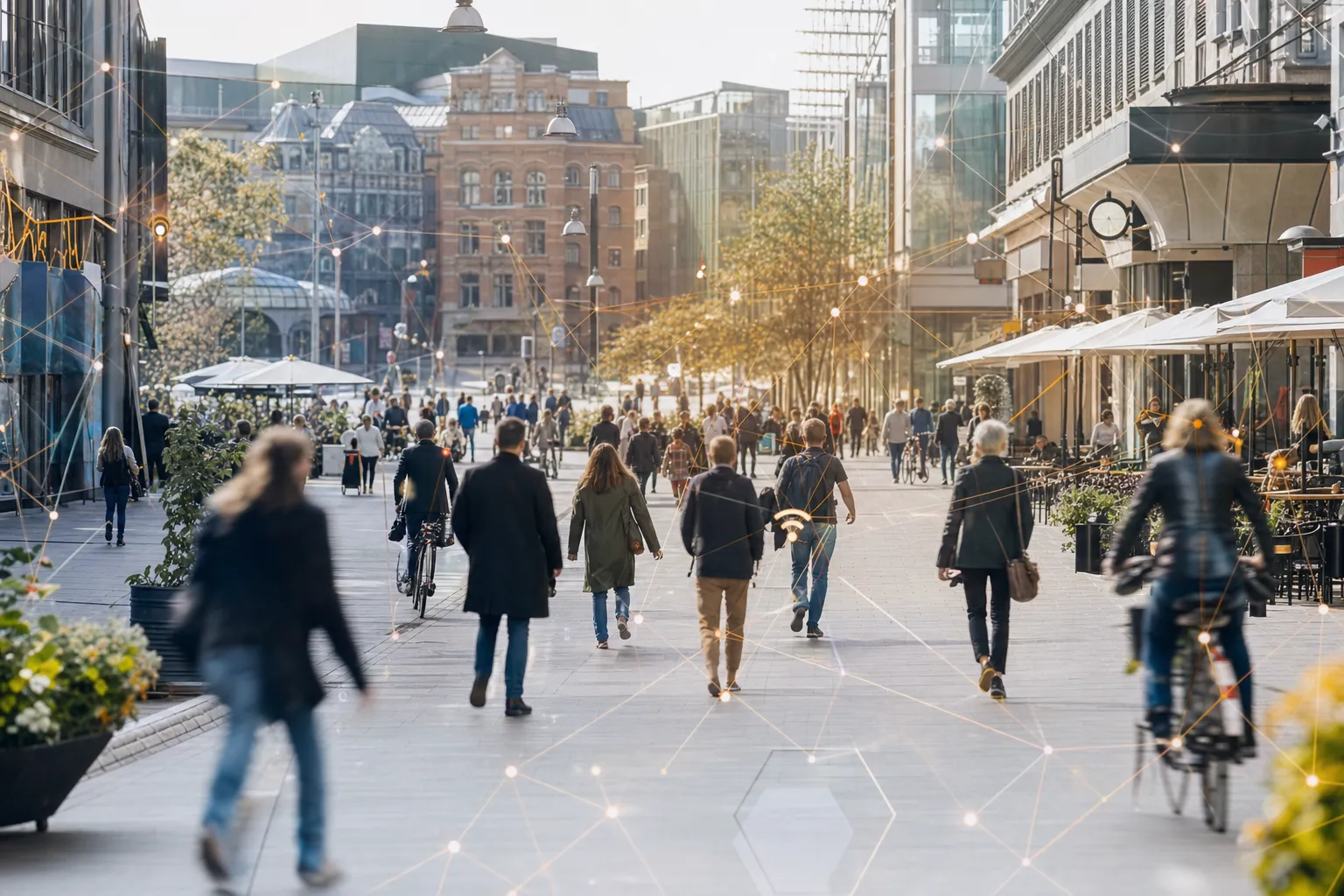
A city planner stands at the corner of a high street that, on paper, has everything: a pharmacy, a GP surgery, a supermarket, three cafés, a library, a primary school. Well-served by every conventional measure. And yet the street feels quiet. The cafés are half-empty on weekday mornings. The library reports falling visits. Residents say the place feels dead.
The problem is not what is on the map. The problem is what is happening, or not happening, in the space between the map and the people who supposedly live within 15 minutes of it. That gap is what footfall data is built to close.
The idea behind the 15-minute city
The concept belongs to Carlos Moreno, an urban scientist at the Université Paris 1 Panthéon-Sorbonne and an adviser to Paris Mayor Anne Hidalgo. Moreno articulated it around 2016: a city works well when residents can reach the six essential functions of urban life (living, working, supplying, caring, learning, enjoying) within 15 minutes on foot or bicycle. No long commute, no car dependency, no neighbourhood that serves only one purpose at one time of day.
Paris gave the concept institutional weight when Hidalgo adopted it as a planning framework. Then the pandemic made it viscerally real: millions of people spent months discovering what it actually meant to live within a 15-minute radius, for better or worse.
The gap between design and reality
The 15-minute city is an accessibility concept. Planners can model it from maps, how many residents are within 15 minutes’ walk of a supermarket?, but accessibility is not the same as use.
A neighbourhood can be theoretically complete and functionally moribund.
A transit hub can sit in a 15-minute zone without connecting to destinations people actually want to reach.
Planning decisions about where to invest, which streets to pedestrianise, where to add cycle infrastructure, and which commercial units to activate need to be grounded in how people actually move, not how they theoretically could. The question shifts from “is the pharmacy within 15 minutes?” to “do people walk to the pharmacy, or do they drive to the one on the ring road?”
Town centre footfall analytics starts from that second question. A site selection analysis built on real movement data, not modelled demographics, is how a planning vision gets tested before money is committed.
What district-scale movement data shows
The flows through an urban district are not random. They have a structure: the routes people habitually take, the nodes where they aggregate, the edges of the neighbourhood where movement drops off sharply. They also have a rhythm: morning peaks, lunchtime pulses, evening surges, weekend patterns that look nothing like weekdays, seasonal variations that tell you whether the high street is actually serving its local population or drawing visitors from further away.
Cellular network analytics captures this at a scale that no manual survey can match. As mobile devices interact with 4G and 5G network infrastructure throughout the day, those interactions, aggregated and anonymised, resolve into a detailed picture of movement across a whole district. The data shows not just volume but origin: are the people on the high street at 11am residents of the surrounding streets, or are they coming from further afield? Are they walking from home or arriving by public transport?
For cities and municipalities making decisions about pedestrianisation, market days, or where to concentrate business improvement district spending, urban footfall analytics at district scale is a different order of information from a traffic count or a survey. The same district-scale flows are what outdoor & DOOH advertising uses to value street-level audiences.
The high-street health check
High streets across Europe have spent years navigating the shift to e-commerce, changes in anchor tenants, and the aftershocks of the pandemic. The conversation about high-street health tends to be dominated by vacancy rates and business rate receipts, lagging indicators that confirm something went wrong long after the damage was done.
Footfall is a leading indicator.
A street that is losing visitors before it loses tenants gives planners and local authorities the chance to respond while there is still something to respond to. Conversely, dwell time rising even as visitor numbers flatten suggests the mix is right and people are staying longer, a fundamentally different story from the same visitor count with falling dwell time, which means people are passing through without finding a reason to stop.
The data deliverables from a district-level analytics programme typically include zone-level volume, peak hours, dwell-time distributions, and catchment analysis, where visitors are coming from. That combination allows planners to answer a question that pure footfall counts cannot: is this street genuinely local, serving its neighbourhood, or is it surviving on visitors from outside it?
The 15-minute city, measured
The gap between planning ideal and lived experience is not a reason to dismiss the 15-minute city concept; it is a reason to measure it. If the vision is a neighbourhood where residents meet everyday needs within a short walk, the evidence of whether that is working sits in how people actually move, not in the planning documents that say how they should.
Measuring the pulse
The metaphor of the pulse is not decorative.
A healthy neighbourhood has a rhythm: the morning movement to schools and transport, the lunchtime animation of the high street, the after-work peak, the weekend dynamic that looks nothing like the weekday. A neighbourhood that has lost its rhythm, where the pattern is flat, where the peaks have gone, is telling you something that vacancy rates will only confirm later.
Reading that pulse means measuring flows anonymously, at scale, and over time, not a snapshot but a longitudinal record that shows change. It is the only footfall method in Europe approved by a data protection authority that captures the movement of a district without identifying a single person who walked through it. The data deliverables from a programme like this give cities and municipalities the evidence to plan, not just aspire.
- 15 minutes
- Walk or cycle to daily essentials
- six
- Essential functions of urban life
Frequently asked questions
What is the 15-minute city concept?
The 15-minute city is an urban planning idea associated with Paris-based professor Carlos Moreno, developed around 2016, in which every resident can reach the essentials of daily life (work, food, healthcare, education, culture) within a 15-minute walk or cycle from their home. The concept gained wide attention after Paris Mayor Anne Hidalgo adopted it as a policy framework, and accelerated further during the pandemic when short-radius living became the norm for millions of people.
How do you measure whether a district is a 15-minute city?
Partly through mapping infrastructure, are the services physically there?, but also through measuring how people actually move. If residents are still driving across the city for everyday errands despite local amenities existing, the neighbourhood has not functionally achieved 15-minute status. Footfall and mobility data at district scale reveals the real patterns of movement, not just the theoretical accessibility.
What is cellular network analytics and how does it measure urban flows?
Cellular network analytics aggregates signals from mobile devices as they interact with 4G and 5G network infrastructure. Because nearly everyone carries a phone, this method captures movement across a whole district without cameras, apps or identification of individuals. It reveals the volume and direction of flows between zones, the times of day when a high street is busy, and how those patterns shift across seasons or after a new development opens.
Can footfall data help with high-street health assessments?
Yes. Volume and dwell-time data shows which parts of a high street are genuinely busy, which are in decline, and which recover after interventions like pedestrianisation, a new anchor tenant, or a public event. Tracking that over months and years gives planners and property owners evidence to support investment decisions rather than relying on business rate data, which lags by years.