
3D sensor people counting
Pinpoint accuracy where it matters most: exact in/out counts and real-time occupancy at entrances and bottlenecks, from optical 3D sensors and AI. No personal images stored.
Optical 3D sensors (Xovis, Flir/Brickstream) + AI. Exact counts, no images stored.
Trusted by









Key benefits
-
Exact in/out counts
Optical 3D sensors deliver precise directional counts at entrances and exits, with line-crossing accuracy where it matters most.
-
Bottlenecks & dwell
Detect crowding, dwell times and queues in real time, so you can keep spaces flowing and staff to demand.
-
Occupancy, privately
Real-time occupancy for safety and compliance. Video is processed for analytics only; no personal images are stored and no individuals are identified.
-
Trains the wider model
Sensor data doubles as validation: a constant flow of control data that calibrates and sharpens Wi-Fi and other methods over time.
How it works
-
Sense
Overhead optical 3D sensors detect people crossing a line or occupying a zone, processing video on the fly for analytics only.
-
Count, privately
The system produces counts and occupancy. No personal images are stored and no individual is identified.
-
Analyse
AI turns the stream into exact in/out, live occupancy, dwell and queue metrics at the point.
-
Deliver
Metrics flow into the same API and dashboards as every other method, one platform, one source of truth.
What data you get from cameras & 3D sensors
This is Bumbee Labs' precision method, strongest at a defined point. Typical metrics from a camera/3D installation:
- Exact in / out counts (directional line-crossing)
- Visitor count (total) at the point
- Real-time occupancy and capacity against safe limits
- Dwell and queue length at the entrance or bottleneck
- Peaks & lows at the measured point
For whole-space behaviour (paths, zone correlation, conversion across a site), combine with Wi-Fi. See the method-by-method grid.
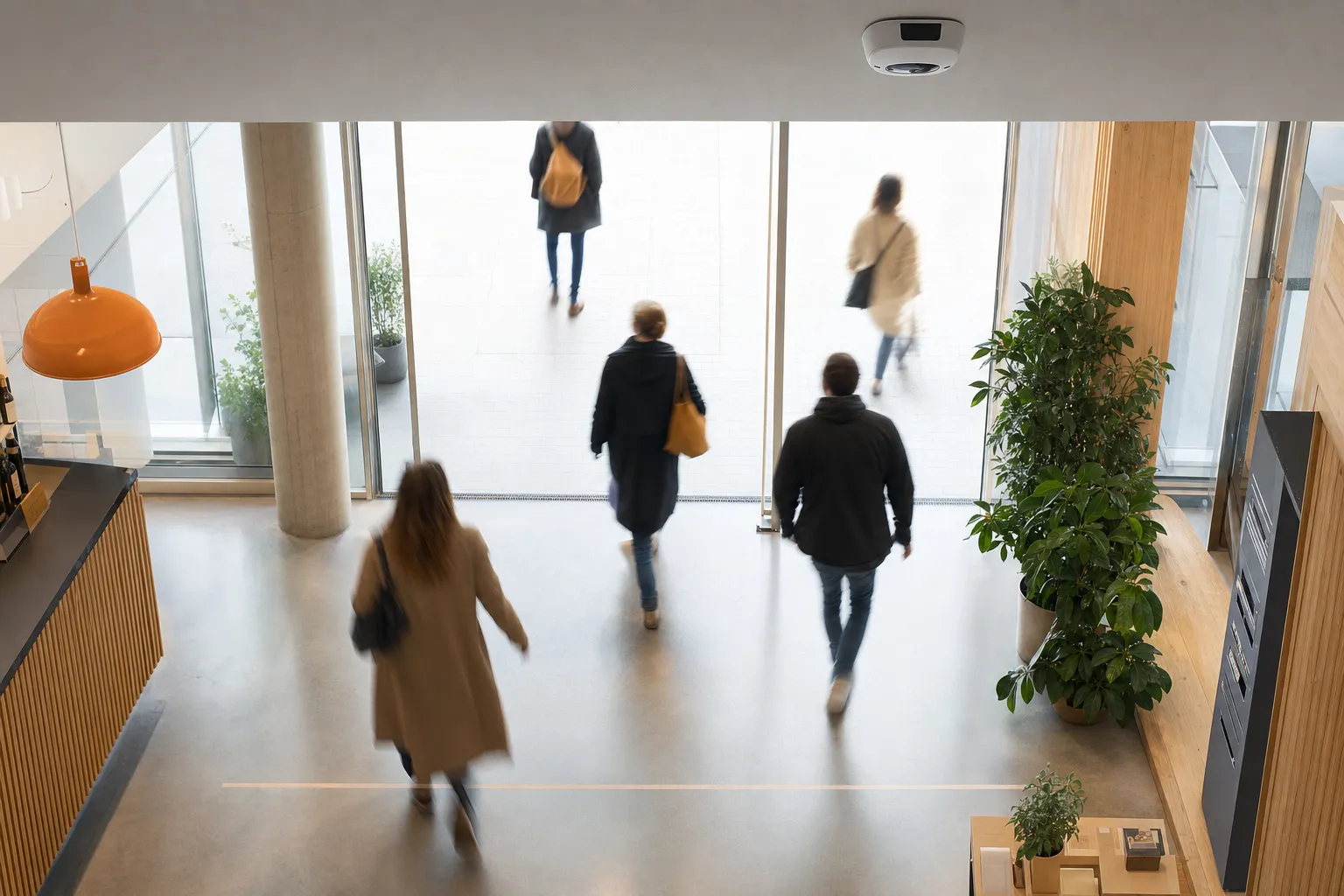
3D sensor people counting at the points that count
Our 3D sensor solution uses purpose-built optical 3D sensors (such as Xovis and Flir/Brickstream) combined with AI analytics. Looking for counting built into standard network cameras instead? See AI camera people counting. It’s built for the places where a number has to be exact: a main entrance, a security lane, a gate, delivering precise in/out counts and real-time occupancy monitoring, and it complements our Wi-Fi and cellular methods where you need micro-level accuracy at a specific door.
Crucially, it does this without storing personal images. Video is processed for analytics only, and what comes out is counts and occupancy rather than footage of anyone.
Unlike a basic people counter box that reports only a raw door total, 3D sensor analytics delivers real-time occupancy, dwell at specific points and queue metrics, all feeding the same platform as your Wi-Fi, LiDAR and cellular data. See how the two approaches compare on the people counter vs analytics guide.
Already run Xovis sensors? You do not need to start over. We can process the data from your existing Xovis hardware into GDPR-compliant footfall analytics, no new sensors required.
Real-time occupancy: decisions that can’t run on an estimate
You can’t manage a safe occupancy limit, staff a check-in lane, or trigger a queue intervention on “roughly”. For those moments you need exact, directional, real-time counts at a defined point, and you need them without the privacy baggage of stored video. That’s exactly what 3D sensors deliver. Those exact door counts also give the in-store conversion rate a denominator it can trust.
Where it fits best
- Retail & supermarkets: exact entrance counts to optimise cashier staffing.
- Airports: track passenger queues at check-in and security for faster processing.
- Events & arenas: stay within occupancy limits while keeping people moving safely.
Better together
Sensors and Wi-Fi solve different halves of the same problem: precision at a point and coverage across a space. Run them together in a hybrid setup and each makes the other better. Sensors give Wi-Fi a reliable ground truth to calibrate against, Wi-Fi gives sensors the context of the whole journey. → Compare the methods on the data deliverables page.
Camera & 3D vs other counting methods
Each method has a sweet spot. Sensors win on point precision; add Wi-Fi or cellular when you need coverage beyond the door.
| Capability | Wi-Fi | Camera & 3D | Cellular | LiDAR |
|---|---|---|---|---|
| Whole-space coverage | Yes | Partial | Yes | Partial |
| Exact in/out at a door | Partial | Yes | No | Yes |
| Real-time occupancy | Partial | Yes | No | Yes |
| Paths & flows between zones | Yes | Partial | Partial | Partial |
| Dwell time | Yes | Yes | Partial | Yes |
| Catchment / origin | No | No | Yes | No |
| Uses your existing hardware | Yes | No | Yes | No |
| Privacy-first by design | Yes | Yes | Yes | Yes |
- Full
- Partial
- Not available
Curious what this looks like for your venue?

Precision with a clean conscience
Bumbee Labs runs the only footfall method in Europe approved by a data protection authority, with validation from academia, partners and customers behind it. Exact counts, zero personal data.
Telia's partnership with Bumbee Labs is important for us to expand our business. It allows us to develop our use cases for location and movement insights to be even more granular. By combining our anonymized and aggregated mobile network data with Bumbee Labs solution of GDPR-safe Wi-Fi probe data, we ensure that the collection of data follows the strictest guidelines of GDPR compliance all the way.
Frequently asked questions
How is this different from Wi-Fi counting?
Wi-Fi gives macro insight across large spaces, like paths, dwell and conversion over a whole store or district. Cameras and 3D sensors give micro-level precision at a specific point, like exact in/out and live occupancy at one door or gate. Many venues combine both, with sensors at key entrances and Wi-Fi across the floor.
Do you store images of people?
No. The solution processes video for analytics only. No personal images are stored, and no individuals are identified. The output is counts and occupancy, not footage.
Which sensors do you use?
Optical 3D sensors such as Xovis and Flir/Brickstream, combined with AI analytics, chosen for the venue and the precision required. If you already own Xovis sensors, we can process their data for you.
Can sensor data improve our other measurements?
Yes. Because sensors give a reliable ground truth at a point, their data is ideal training and validation data. It calibrates Wi-Fi and other methods and helps maintain accuracy over time, especially in permanent installations.