
Visitor analytics for public transport hubs
Smarter mobility and smoother passenger journeys. Balance flow, safety and commercial opportunity across stations, terminals and interchanges.
Measured across concourses, platforms and retail zones, privacy-first.
Trusted by









Why transport operators choose Bumbee Labs
-
End-to-end flow
See how travellers move through concourses, platforms and retail, and where bottlenecks form.
-
Privacy-first
Anonymous, aggregated measurement that never identifies a traveller.
-
Plan with confidence
Optimise routes, schedules and staffing, and measure the impact of changes.
How it works
-
Measure
Usually on the access points already deployed across the station (only those needed), with a few extra to cover passing-by frontages and key entries/exits.
-
Process
The anonymous data is filtered and processed in Bumbee Labs' statistical engine, then calibrated against manual control counts.
-
Deliver
Stakeholder dashboards on the Explore portal, or into your own BI via a well-documented API.
What data you get
Hubs are measured as zones (ticketing, platforms, waiting areas, food court, shops, corridors), each tracked on its own and in relation to the others:
- Visits and dwell time, total and per zone
- Real-time crowding for live bottleneck and crowd management
- Paths, flows and zone correlation, origins, destinations and cross-shopping
- Entry/exit and catchment, combinable with cellular data for the wider area
- The conversion funnel: passers-by → enter → stay → buy
- Advertising exposure, reach, impressions and dwell at screens and event spots
- Periodic reporting for staffing, cleaning, maintenance and stakeholder communication
Combine with operator cellular (4G/5G) data to understand movement in the wider catchment beyond the station.
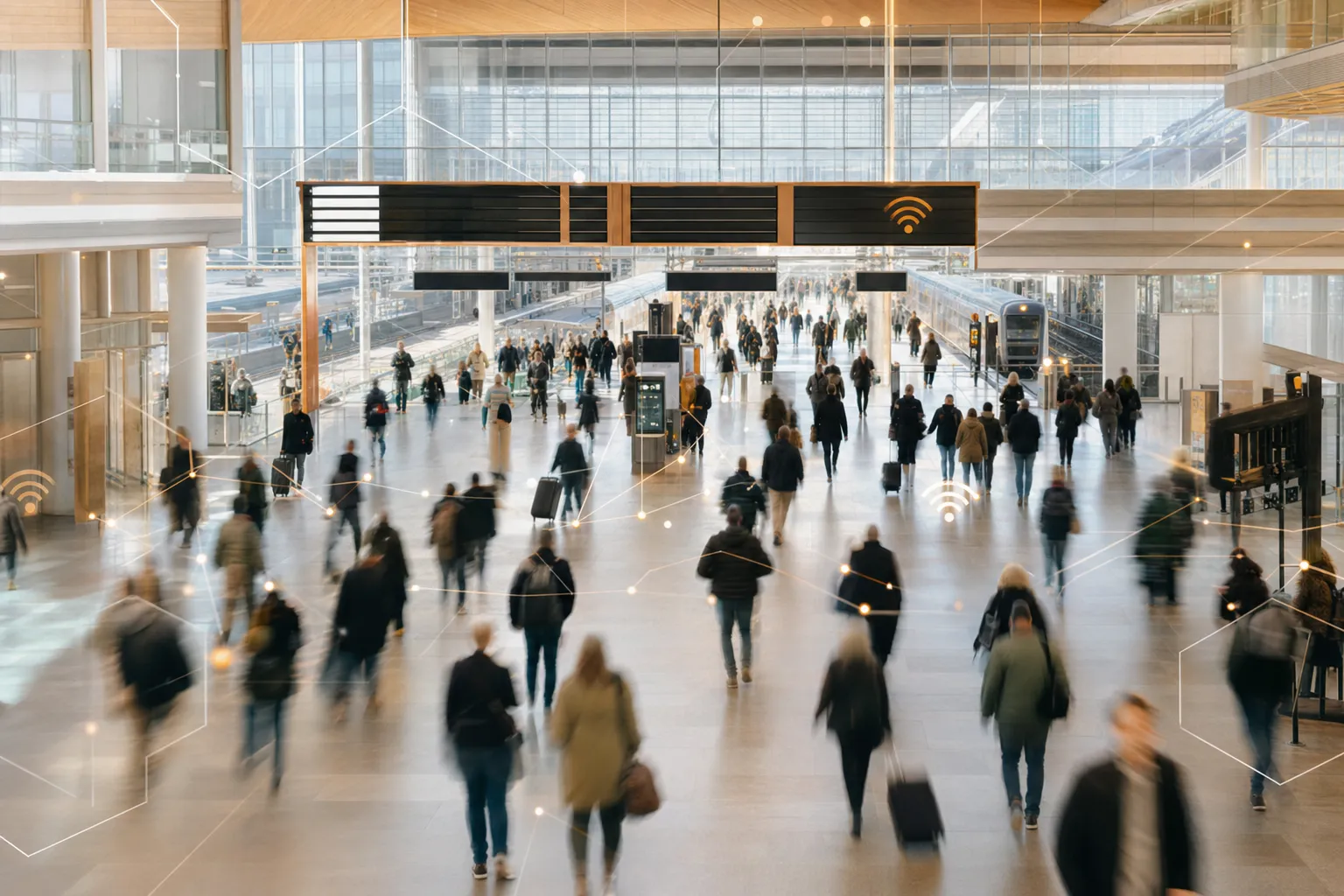
The beating heart of urban mobility
Transport hubs, from metro and bus stations to terminals, are where mobility succeeds or stalls. Managing them well means balancing passenger flow, safety and commercial opportunity, across distinct zones (ticketing, platforms, waiting areas, food court, shops, corridors) that are run differently but depend on each other. Privacy-first visitor analytics give you the insight to optimise routes, reduce congestion and make the most of your facilities. This is the only footfall method in Europe approved by a data protection authority; no traveller is ever identified.
What operators use it for
- Reduce transport-planning costs and optimise routes, schedules and staffing with real passenger counting data.
- Improve the traveller and commuter experience, and allocate resources for a smaller carbon footprint.
- Identify hot and cold zones, bottlenecks and anchor stations.
- Lift retail and F&B spend, and value advertising and event spaces on real exposure.
Proof: a major Stockholm transport hub
A major Stockholm transport hub, a large mix of shops and restaurants, very high daily commuter volume, chose Bumbee Labs for accuracy and documented GDPR compliance. With zone analytics it re-planned staffing, lifted shop and F&B spend, reduced bottlenecks and crowding, and valued its advertising spots, even using footfall as a currency in tenant rent talks. Read the transport hub case →
Curious what this looks like for your venue?

Compliant where it counts
Anonymous, aggregated and approved by a data protection authority, with validation from academia, partners and customers behind it.
Having the large flows we have is a challenge. We constantly strive to have as efficient a station as possible. With the help of reliable data from the new measurement system, we can better plan where different service functions or stores are to be located and how we can adapt doors or passages.
Frequently asked questions
Can large, multi-entrance stations be measured accurately?
Yes, and counter-intuitively, very high visitor numbers make the data more accurate, not less, because the method is statistical. Camera and sensor systems often struggle with many entries/exits and with visitors who leave and return during one trip.
Can we see where travellers come from and go to?
Yes. Entry/exit and origin are measured, and can be combined with operator cellular (4G/5G) data for movement in the wider catchment beyond the station.
Do we need to cover the whole station with Wi-Fi?
No. Covering entries/exits, key corners and hot spots is usually enough. Each visitor gets an anonymous alias that's recognised as they move between measured zones.