
DOOH audience measurement in real numbers
Digital out-of-home advertising is sold on impressions. The honest question is whether those impressions bear any resemblance to the people who actually pass by.
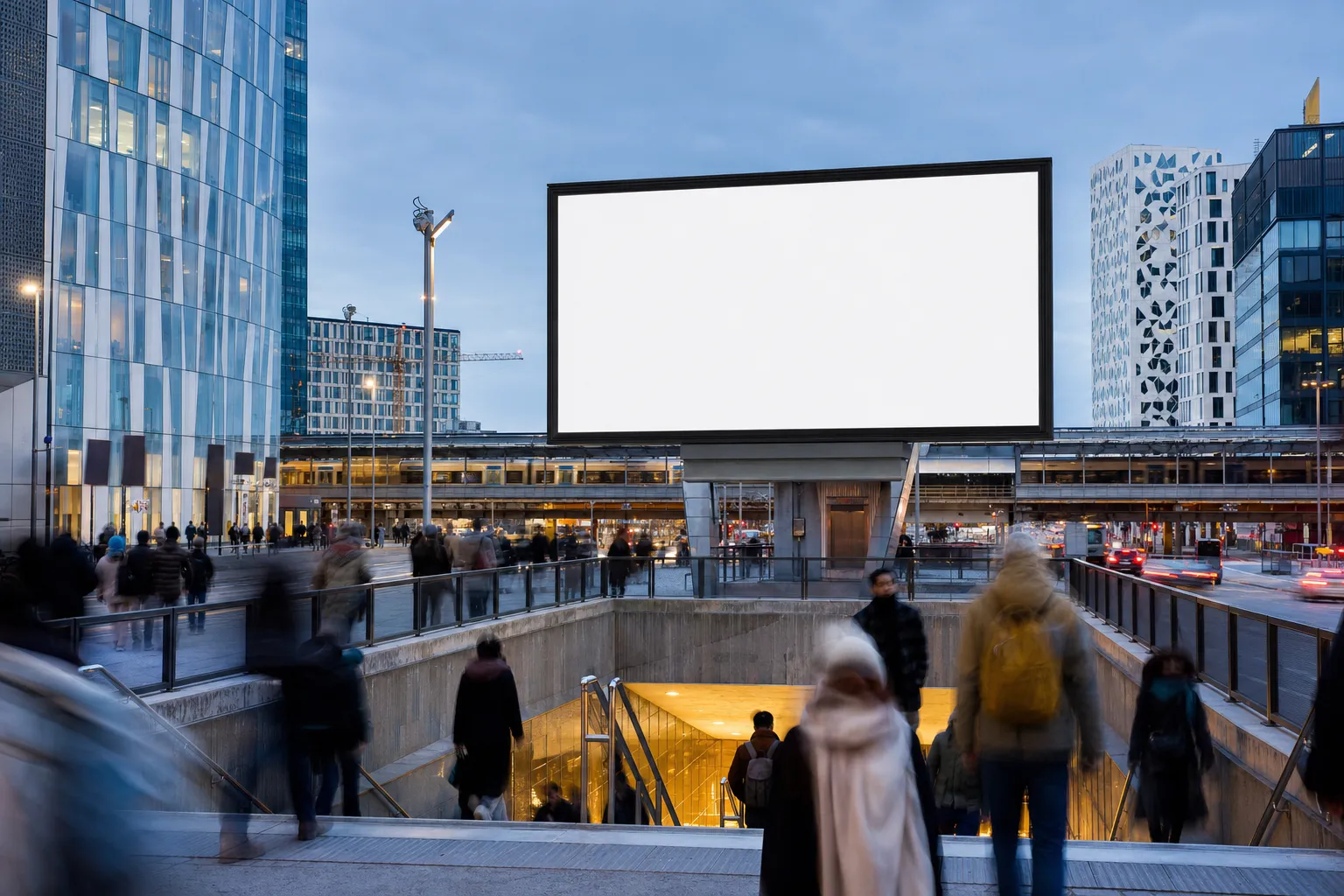
Someone walks past a digital screen in a train station. The screen plays a fifteen-second clip for a car brand. Did an impression just happen?
In online advertising, an impression is a served event: the platform logged that an ad loaded, and there are audit trails for it. In digital out-of-home, the equivalent is murkier. The screen played. Whether the person who walked past looked at it, noticed it, or was even within a plausible viewing distance when the relevant frame appeared, none of that is straightforwardly knowable. DOOH is still bought and sold on impressions, often quoted in the millions.
This gap between the metric and the reality it is supposed to represent is the central challenge of DOOH audience measurement. It is also where more rigorous footfall data makes a genuine commercial difference.
A $27 billion industry without universal measurement standards
The global DOOH market was valued at around $27.5 billion in 2024, according to Straits Research, with inventory now running to an estimated 7 million screens, roadside billboards, metro systems, airports, bus shelters, in-store retail media networks.
Despite that scale, the industry lacks universal measurement standards.
Broadsign has documented multiple competing methodologies: Visibility Adjusted Contact, Average Unit Audience, Viewable Impressions, Likelihood-to-See, each applying discount factors to raw circulation counts in different ways.
The result is that “impressions” from one network may be calculated on a substantially different basis from impressions on another, making cross-channel comparison unreliable.
This is not a new problem. It is the problem the industry has been attempting to solve for a decade.
Who sets the standard? Audience currencies in OOH
No universal standard does not mean no standards at all. Several markets run national “audience currencies”, measurement systems that advertisers, agencies and media owners jointly agree to trade on. In the United States that body is Geopath, which publishes audited impressions, reach and frequency for OOH inventory. In the UK it is Route, the joint industry currency for out-of-home, owned collectively by advertisers, agencies and media owners. Several other European markets maintain currencies of their own, each with its own methodology.
These currencies make trading within one market consistent, but they do not remove the underlying question: every methodology still rests on an estimate of how many people were actually at the location. That is why verifiable, measured footfall holds its value whichever currency a market trades in — it is the ground-truth input any audience model needs, and the check a buyer can hold modelled numbers against.
The DOOH metrics glossary: impressions, CPM and the impression multiplier
The terms the industry trades on, defined honestly:
Impression. In DOOH, an impression is a potential exposure — an estimate of how many people had a plausible opportunity to see a play — not a served-and-logged ad event as in online advertising. Every number below inherits its credibility from how the impressions were produced.
Impression multiplier. The estimated number of people who see one play of an ad. One screen, one play, many viewers: the multiplier converts play counts into impression counts, and programmatic DOOH pricing depends on it. It needs real footfall data as its input — a multiplier applied to measured passage is an estimate; applied to a modelled traffic figure, it is a guess, multiplied.
CPM. Cost per mille — the price of a thousand impressions: media cost divided by impressions, times one thousand. The arithmetic is trivial; the meaningful part is the denominator. A CPM computed from measured impressions is a price. One computed from inflated impressions is a discount dressed as a price.
Plays (or spots) and loop. A play is one showing of an ad. Screens run a loop — a repeating sequence of ads of fixed length — so an ad’s share of the loop determines how many plays it receives per hour of screen time.
Share of voice. The proportion of a loop, or of a network’s total plays, that one advertiser occupies.
Reach and frequency. The two metrics measured footfall supports most directly — defined in full in the reach and frequency section below.
Dwell time. How long people stay near a screen. Dwell determines how much of the loop an audience actually has time to see: a metro platform where people wait for minutes is a different advertising proposition from a corridor they cross in seconds, even at identical footfall.
What OTS actually measures
Opportunity-to-see (OTS), still the most widely used DOOH metric, starts from a traffic or footfall count and asks how many of those people were in a position to see the ad. The calculation involves assumptions about viewing angles, minimum legible distances, average movement speed, and the share of passersby likely to glance at a screen.
Those assumptions vary by methodology, but the underlying input, how many people were actually near the screen, needs to be right for any adjustment to mean anything. A circulation figure based on an outdated traffic model, or estimated from census data rather than measured, introduces error at the foundation that no methodology can correct.
Accurate footfall counts are not a luxury refinement; they are the prerequisite for credible audience estimates. Visitor analytics for outdoor and DOOH advertising starts with that foundation.
The cellular advantage for outdoor locations
For screens in publicly accessible outdoor locations (high streets, transport interchanges, open squares, motorway services) cellular network analytics provides a measurement approach that works at scale without requiring any on-site sensor installation. Mobile network operators process aggregated, anonymised data about device presence; that data can be used to produce accurate counts of how many people were within a defined area during any given time window.
This is particularly useful for DOOH audience measurement because it covers the full range of audience types: pedestrians, cyclists, motorists passing slowly, and transit passengers. A roadside billboard, a bus-shelter panel, and a station concourse screen have fundamentally different audience compositions; cellular data captures all of them within the same methodology.
For DOOH advertisers and media owners, this means moving from modelled estimates to measured counts, and being able to show that difference to a client or agency.
Reach, frequency, and OOH impressions
Two metrics that translate well from online into DOOH, and that footfall data can genuinely support, are reach and frequency. Reach is the number of distinct people who passed a screen at least once during a campaign period. Frequency is how many times the average person in that audience was exposed. Together with exposure duration, these form the foundation of credible OOH impressions reporting.
Both require counting methodology that distinguishes repeat visits from unique visitors. For high-footfall locations like transport hubs or shopping districts, the same population cycles through repeatedly, a commuter passes the same concourse display five days a week. Without de-duplication, that person counts as five impressions in a raw OTS figure; with it, they count as one reach unit with a frequency of five. The distinction matters to planners building campaigns with reach objectives.
Events create a different challenge: a market, a festival, a concert, or a product launch can temporarily multiply the audience at a location well beyond its baseline. The data deliverables from footfall analytics include time-stamped counts that show exactly when those spikes occurred and how large they were, useful for measuring event impact on DOOH exposure as well as on commercial footfall.
Programmatic DOOH runs on measurement
A growing share of DOOH inventory is now bought programmatically: automated deals priced per impression, with the impression counts produced by applying a multiplier to each play. That mechanism has a simple property — garbage in, garbage out. An impression multiplier applied on top of a modelled traffic figure inherits the model’s error and passes it on to every buyer in the chain. The same multiplier applied on top of measured footfall turns the same screens into inventory a media owner can sell programmatically with numbers that survive scrutiny. For media owners preparing inventory for programmatic pipelines, DOOH analytics for media owners covers what can be measured per placement.
From screen to store: campaign impact on footfall
The question behind every DOOH budget: did the campaign move anyone? Individual-level attribution — tracing a specific person from a screen exposure to a store visit — is not something anonymous, aggregated measurement can do, and claims to the contrary deserve scrutiny, especially in Europe.
What aggregated footfall data can honestly show is impact at the population level. Measure footfall at the destination before, during and after the campaign, compare it against a baseline that accounts for weekday rhythm and seasonality, and the campaign’s effect appears as a deviation from what the location would have done anyway. It is the same before-and-after methodology used for measuring event impact, applied to a media campaign. The result is a more modest claim than an attribution chain — footfall rose by this much while the campaign ran — but it is a claim that holds, made from data in which no individual can be identified.
What the data is, and what it isn’t
Overclaiming is a recurring problem in DOOH measurement, so it is worth being precise.
Footfall counts tell you how many people were near a screen and when. They do not tell you how many looked at it, how long they spent looking, or whether the creative registered. Attention measurement , camera sensors pointed at passersby, exists as a separate category, but it brings its own privacy implications and faces stricter regulatory requirements across Europe.
Footfall-based OTS is a more modest but more defensible claim: this many people were in a position to see the screen. Stated accurately, that is a genuinely useful planning number. Inflated, it erodes advertiser trust in the whole medium.
The measurement is anonymous throughout. Cellular network analytics and Wi-Fi-based sensing both produce aggregate statistics, counts and patterns, not records of individuals. No profile attached to any passerby, no journey reconstructed, no identity inferred.
The audience was counted. It was not watched.
For DOOH advertisers who need to show clients what the inventory actually delivers, that distinction is increasingly what separates a credible media owner from an optimistic one.
- $27.5 billion
- Global DOOH market value in 2024
- 7 million
- Estimated DOOH screens in inventory
Frequently asked questions
What is an OTS or opportunity-to-see in DOOH advertising?
Opportunity-to-see (OTS) is an estimate of how many people were in a position to view an ad during a campaign. It is derived from traffic or footfall counts near the screen, adjusted for factors like viewing angle, display size, and typical walking pace. OTS is not a count of people who looked at the screen, it is a count of people for whom viewing was plausible.
How is DOOH audience measurement different from online ad measurement?
Online advertising measures actual clicks, impressions served, and in some cases view time, all at the individual level. DOOH measurement is inherently aggregate: you can count how many people passed a screen, and estimate how many had a plausible view, but you cannot verify individual attention. The challenge is moving from traffic counts to credible audience estimates.
Can cellular network data improve DOOH audience measurement?
Yes. Cellular network analytics can provide accurate counts of how many devices (and by calibrated extension, people) were present in the vicinity of a screen during a campaign period. This is a more grounded input for audience estimates than modelled traffic figures, and it covers both pedestrian and vehicular audiences where relevant.
What data should a DOOH operator or advertiser ask for?
Ask for verified footfall counts for the screen location, ideally broken down by time of day and day of week, plus any dwell or proximity data that indicates how long people were near the display. Distinguish clearly between raw circulation figures and adjusted OTS estimates, both have their uses, but they are different numbers.
What is an impression multiplier in DOOH?
An impression multiplier is the estimated number of people who see a single play of an ad on a screen — the factor that converts play counts into impression counts, which programmatic DOOH pricing depends on. Its credibility depends entirely on its input: a multiplier needs measured footfall at the location, how many people actually pass and when, rather than a modelled traffic estimate.
How is DOOH CPM calculated?
CPM (cost per mille) is the media cost divided by the number of impressions, multiplied by one thousand. The formula is simple; what varies is the impression count in the denominator. In DOOH, impressions are typically plays multiplied by an impression multiplier, so a CPM is only as trustworthy as the audience measurement behind that multiplier.
Can DOOH campaigns be linked to store visits?
Not at the individual level: anonymous, aggregated measurement cannot trace a specific person from a screen to a store, and in Europe that is a feature, not a limitation. What it can show is aggregate impact — footfall at the destination before, during and after the campaign, compared against an honest baseline. A rise beyond what weekday patterns and seasonality explain is evidence the campaign moved people, measured without tracking anyone.