
Customer counter or analytics platform: which do you need?
A simple counter at the door is enough when one number answers your question. If you also need to know how many walked past, where visitors went, how long they stayed and how sites compare, you need analytics. A door counter shows one door, while Wi-Fi analytics covers the whole space.
On this page
What is the difference between a customer counter and an analytics platform?
A customer counter, also called a people counter or door counter, is a device: a unit above a door that produces a number, typically in and out. People counting analytics is a service: counting plus the statistics, dashboards and integrations that make the numbers usable across a business. Either can be the right purchase. If you searched for a people counter, decide first which questions the number has to answer, then choose the device.
The short version
- A door counter gives one number at one door, and analytics adds the passers-by, paths, dwell and comparisons that number cannot show.
- 3D sensors, AI cameras and LiDAR give exact counts at a door, while Wi-Fi covers a whole space, usually with no new hardware.
- Compare quotes on installation, coverage, platform, integration and compliance as well as on the device.
- Ask any supplier which authority has reviewed the method and what data leaves the sensor.
What does a simple footfall counter do well?
If you run a single entrance and need a headline visitor count, a basic optical counter at the door can be enough. Bumbee Labs’ own precision method also works at the door: 3D sensors give exact directional in/out and occupancy at the door, and no personal images are stored. AI people counting cameras do the same job with standard camera hardware, and LiDAR does it without a camera.
What does analytics add to a door counter you already have?
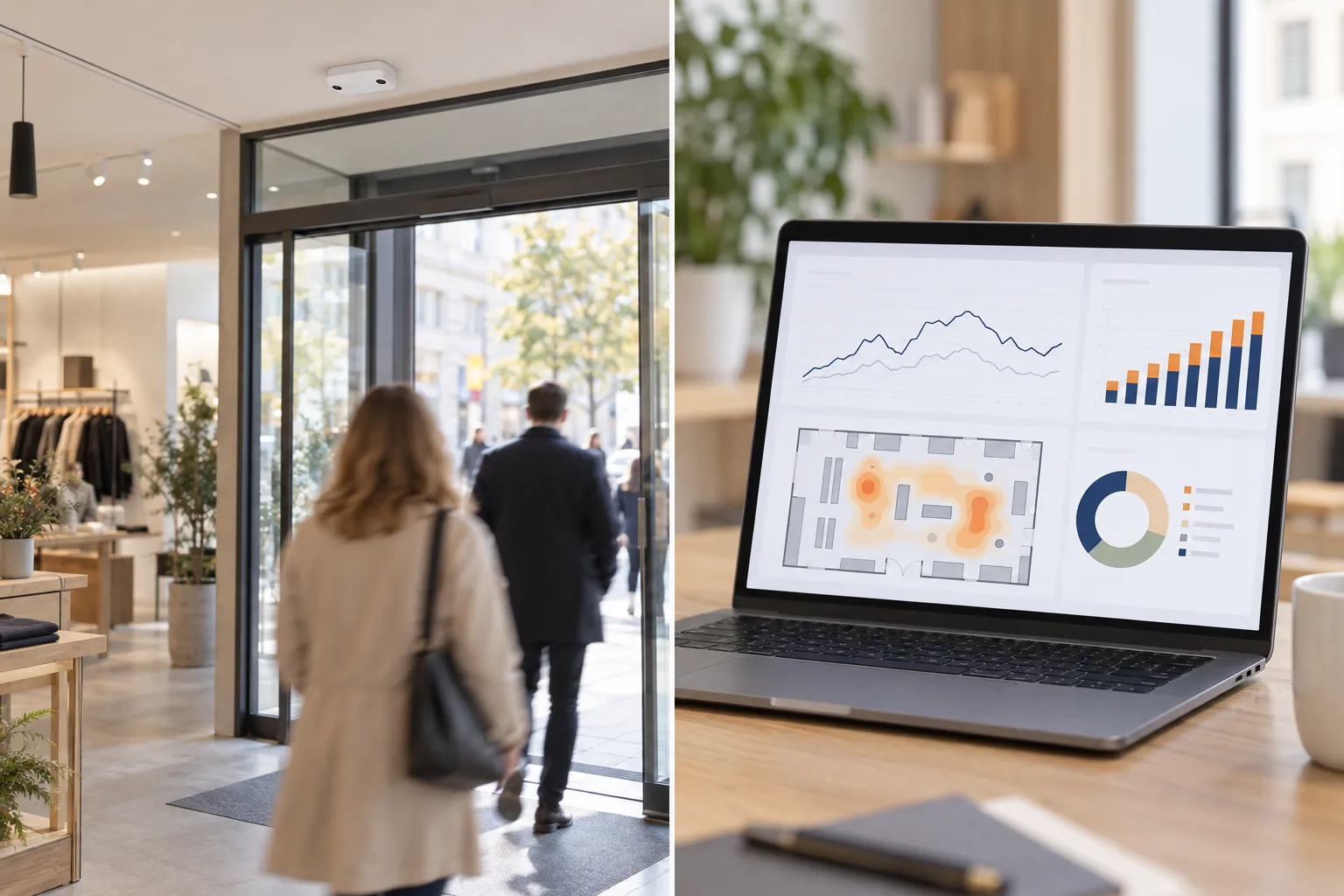
A counter that only shows a number above the door answers one question accurately. Analytics adds what it cannot see: the passers-by who never came in, how long visitors stayed, which zones pulled people and which were ignored, how this site compares with the rest of the estate, and what last week’s campaign changed.
- Behaviour: dwell time, visitor paths, zone correlation and capture rate.
- Comparison: unique visitors, peaks and trends, and benchmarking across sites, periods and campaigns. Recurring visits within the same day can also be measured.
- Integration: an open, documented API into the BI tools you already run, with external streams such as POS and weather read alongside footfall.
- Coverage without new hardware: Wi-Fi-based counting works with many existing enterprise access points (Cisco, Ruckus, Aruba and others), so whole-space measurement can start on the network you already operate.
The data deliverables page lists the metrics.
What does accuracy mean for each setup?
A single accuracy percentage means little on its own, because accuracy depends on the method, the placement and the question, whichever brand is on the device. At a doorway, 3D sensors and AI cameras count line crossings directly. Across a floor, Wi-Fi depends on the venue, the placement of access points and calibration, which is why every Bumbee Labs deployment is checked against manual control measurements. Across a district, cellular network data works at a scale no doorway sensor reaches. The method-by-method picture is in people counting accuracy by method.
What do you pay for beyond the device?
The device is the visible cost, but quotes compared on hardware alone can hide most of the difference between suppliers. Ask each supplier about:
- Installation and cabling: per measured point, and what happens when the store is refitted or an entrance moves.
- Coverage: how many points you need before the data answers your question.
- The platform: whether dashboards, comparisons, benchmarking and the API are included or priced separately, and whether historical data stays available.
- Integration work: what it takes to get footfall into the BI tools and reports your team already uses.
- Compliance: whether the method needs a DPIA or a legal review before it can go live, and who carries that work.
Where a venue already runs enterprise access points, Wi-Fi counting re-uses them, which often changes the answers on installation and coverage.
What should a specification say about GDPR?
A specification should ask “Is your people counter GDPR-compliant?” and record the answer. That answer depends on the method and on what leaves the sensor, whatever the product is called. Bumbee Labs’ Wi-Fi counting produces anonymous, aggregated statistics and no personal data, and the detail is on GDPR-compliant footfall analytics.
Bumbee Labs is the company behind the only footfall method in Europe approved by a data protection authority. The authority is IMY, the Swedish Authority for Privacy Protection, and that page explains what its decision does and does not cover.
When you compare suppliers, ask which authority has reviewed the method, what leaves the sensor, and whether the answer is an approval or only the supplier’s own conclusion.
Which setup fits which question?
| Setup | What it measures | Privacy | Installation | Best suited to |
|---|---|---|---|---|
| Simple door counter | A headline number, typically in and out, at one door | Depends on what leaves the sensor | A unit above the door | One entrance and no follow-up questions |
| 3D sensor or AI camera | Exact directional in/out and occupancy at the door | Counts and occupancy only, with no personal images stored in counting mode | Overhead sensors, or standard network cameras that do the counting | Doors and gates where the number must be exact |
| LiDAR | Exact counts, occupancy and paths in any light | No camera and no image | Laser sensors suited to the venue and the area covered | Dark, outdoor or wide-open spaces |
| Wi-Fi analytics | Dwell, paths and conversion across a whole space | Anonymised, aggregated device signals | Usually the access points already in place | Stores, centres and venues with an enterprise network |
| Sensors plus Wi-Fi | Exact door counts and whole-space behaviour together | Anonymous, aggregated statistics | Sensors only at the doors that need them | Precision and coverage together |
Because each method does one part best, many venues combine them in a hybrid setup, with sensor ground truth calibrating the whole-space model.
What that means in your kind of store is on its own page: clothing stores, grocery stores, DIY and hardware stores and pharmacies, with more store types on retail footfall analytics.
When is a door count no longer enough?
Plenty of organisations begin with a door count and meet the harder questions later: why conversion differs between sites, whether the new layout holds visitors longer, what footfall justifies in rent. Those questions need zones, dwell and comparability, which a counter alone cannot provide. For a method-by-method walkthrough of the counting itself, read how to count visitors.
All resources and guides collects the guides, the glossary and selected insights; all insights are under insights.
Curious what this looks like for your venue?
Frequently asked questions
Is a people counter the same as people counting analytics?
They overlap, but they meet different needs. A people counter is a device that gives one number at one point, usually in and out at a door. People counting analytics is a service that turns measurement into statistics such as dwell time, zones, capture rate and comparisons across sites and periods, delivered through dashboards and an API.
How accurate is a people counting system?
Accuracy depends on the method, the venue and the placement, whichever brand is on the device, so one figure quoted for every situation says little about your venue. A door counter is accurate at its door; 3D sensors and AI cameras give exact directional in and out there, and Wi-Fi covers dwell and paths across the floor. Every Bumbee Labs deployment is calibrated against manual control measurements.
Can we get people counting analytics without buying new hardware?
Often, yes. Wi-Fi analytics runs on the enterprise access points many venues already operate, from Cisco, Ruckus, Aruba and other vendors, so most venues can start measuring without new devices. Sensors are added only at the doors that need exact counts.
When is a simple people counter the right choice?
When one number answers the question: there is one entrance, you need a headline count and you have no need for behaviour data, comparison or integration. Once staffing, layout, rent or campaign decisions depend on the data, an analytics platform is the better fit.
Is a people counter GDPR-compliant?
That depends on the method and on how the data is handled, whatever the product is called. Ask any supplier which authority has reviewed their method and what leaves the sensor. Bumbee Labs' Wi-Fi counting produces anonymous, aggregated statistics with no personal data. The company is behind a method approved by a data protection authority.