
Wi-Fi-based people counting
Turn the access points you already run into a footfall sensor network. Counts, dwell, paths and conversion across whole spaces. No cameras, no extra hardware, no personal data.
Works with Cisco, Ruckus, Aruba and other enterprise Wi-Fi. No new hardware.
Trusted by









What makes it work
-
Uses existing infrastructure
Works with leading enterprise Wi-Fi platforms (Cisco, Ruckus, Aruba and more) so most venues can start measuring with no new hardware.
-
Privacy-first by default
Device signals are anonymised and aggregated into counts and flows. No individuals are identified and no personal data is kept.
-
Whole-space coverage
Measures the entire area as one continuous flow, not just islands under a camera. See counts, movement between zones, dwell and conversion.
-
Calibrated to reality
Manual control measurements are matched to our own data and feed the model, so the numbers mirror what actually happened.
How it works
-
Measure
Phones with Wi-Fi on emit signals as people move. Your existing access points pick them up, with no app, no login, no action from the visitor.
-
Anonymise & filter
Personal data is irrevocably deleted, leaving only anonymous statistics. AI filtering strips out noise like randomisation, spoofing, stationary devices and staff.
-
Process & calibrate
The statistical engine extrapolates from complete visits to the true population, fills path gaps, and calibrates against manual control counts.
-
Deliver
Clean, anonymous metrics arrive via the API and your dashboards, ready the day after the visit, with same-day recurring visits supported.
What data you get from Wi-Fi
Wi-Fi is Bumbee Labs' macro method, strongest at covering whole spaces and the journeys across them. Typical metrics from a Wi-Fi installation:
- Visitor count (total) and unique visitors
- Dwell time, per zone and overall
- Visitor paths & flows between zones and between sites
- Zone data & correlation, and anchor positions
- Passers-by and capture rate (passing → entering)
- Peaks & lows and long-run trends
For exact line-crossing in/out and live occupancy at a specific door, pair Wi-Fi with cameras/3D sensors. See the full method-by-method grid.
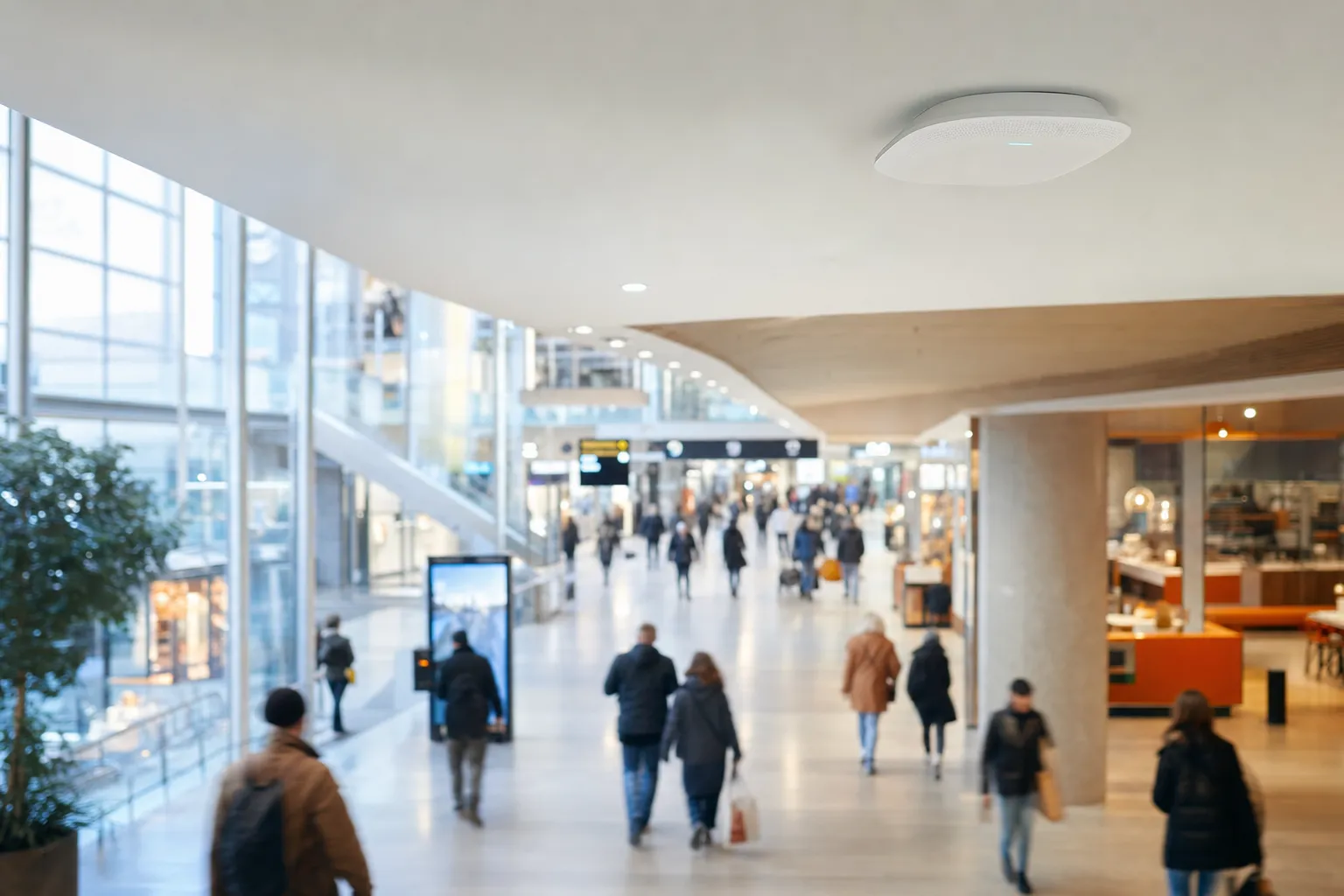
The gap Wi-Fi people counting closes
You can sense that some areas pull traffic and others don’t, that certain hours are dead and campaigns sometimes land. Without data, though, it’s guesswork, and guesswork is expensive when it sets your staffing, your layout and your rent. Cameras give you precision at one door but go quiet everywhere else. Wi-Fi closes that gap: whole-space behaviour, from infrastructure you’ve already paid for, with no privacy exposure. How the method stays on the right side of GDPR is laid out on GDPR-compliant footfall analytics.
Real-time occupancy monitoring, no new hardware
Beyond counting visitors as they arrive, Wi-Fi analytics supports real-time occupancy monitoring: how many people are present in a space at this moment, and how that number builds or clears across the day. It runs on the same access points, with no cameras and no personal data, and the numbers land in the same dashboards and API as the rest of your footfall metrics. Teams measuring foot traffic across European and North American sites run it all on one platform. What live occupancy does for how a venue feels to be in is explored in real-time occupancy and crowd comfort.
Where it fits best
Wi-Fi counting is a strong fit for larger indoor and semi-outdoor spaces where access points are already in place, like shopping centres and city districts, transport hubs, retail and large venues. For entrances that need exact line-crossing counts, it pairs well with our camera and sensor methods in a hybrid setup.
Built on the network you run
Wi-Fi counting is hardware-agnostic: major enterprise platforms are already integrated, so it can read from the access points you operate today. → Works with the enterprise Wi-Fi you already run, including Cisco Spaces, Cisco Catalyst, RUCKUS One, RUCKUS SmartZone, Aruba Central, ArubaOS / ALE, Juniper Mist, Huawei and Extreme Networks. See all supported networks and platforms.
Wi-Fi vs other counting methods
Every method has a sweet spot. Wi-Fi covers whole spaces and the journeys across them; pair it with cameras or cellular where you need point precision or wide-area catchment.
| Capability | Wi-Fi | Camera & 3D | Cellular | LiDAR |
|---|---|---|---|---|
| Whole-space coverage | Yes | Partial | Yes | Partial |
| Exact in/out at a door | Partial | Yes | No | Yes |
| Real-time occupancy | Partial | Yes | No | Yes |
| Paths & flows between zones | Yes | Partial | Partial | Partial |
| Dwell time | Yes | Yes | Partial | Yes |
| Catchment / origin | No | No | Yes | No |
| Uses your existing hardware | Yes | No | Yes | No |
| Privacy-first by design | Yes | Yes | Yes | Yes |
- Full
- Partial
- Not available
Curious what this looks like for your venue?

Compliant where it counts
Wi-Fi counting from Bumbee Labs is the only footfall method in Europe approved by a data protection authority, and it has been validated by academia, partners and customers. Full insight, no personal data, no privacy risk.
By partnering with Bumbee Labs we have opened the door for our end-customers to radically change the way they plan and prepare for the future. They can look to attract more visitors and reform their offer to tailor it to the wants and needs of individuals in and around their sites. This can all be achieved without any additional investment in physical hardware thereby reducing costs, while bolstering their return on investment.
Frequently asked questions
Does Wi-Fi counting identify individual visitors?
No. Signals are anonymised and aggregated into counts and flows, and personal data is irrevocably deleted, so only anonymous statistics remain. The method is designed from the ground up so that no individual can ever be identified.
Do we need to install new hardware?
Usually not. Wi-Fi counting works with many existing enterprise access points (Cisco, Ruckus, Aruba and others are already integrated) so most venues can begin measuring on the network they already operate. Where higher accuracy or extra coverage is needed, a few access points can be added.
How is this different from camera-based counting?
Cameras measure small areas right under the sensor with high precision at a point. Wi-Fi measures the whole space as one continuous flow, so it can describe dwell, paths and zone correlation across an entire store, mall or city centre. Many venues combine the two.
How accurate is Wi-Fi-based counting?
Accuracy is high, and the exact figure depends on the venue, the number and placement of access points and how the installation is calibrated. We verify every deployment with manual control measurements matched to our own data, tune it to the space, and can combine Wi-Fi with other methods where higher precision is needed.
Is it GDPR-compliant?
Yes. Personal data is irrevocably deleted at source, leaving only aggregated statistics, and the method was reviewed and approved by a European data protection authority.