
Real-time occupancy: from crisis counting to everyday crowd comfort
Capacity limits pushed live people-counting into the mainstream. What venues discovered once they installed it was that the use cases extended well past compliance.
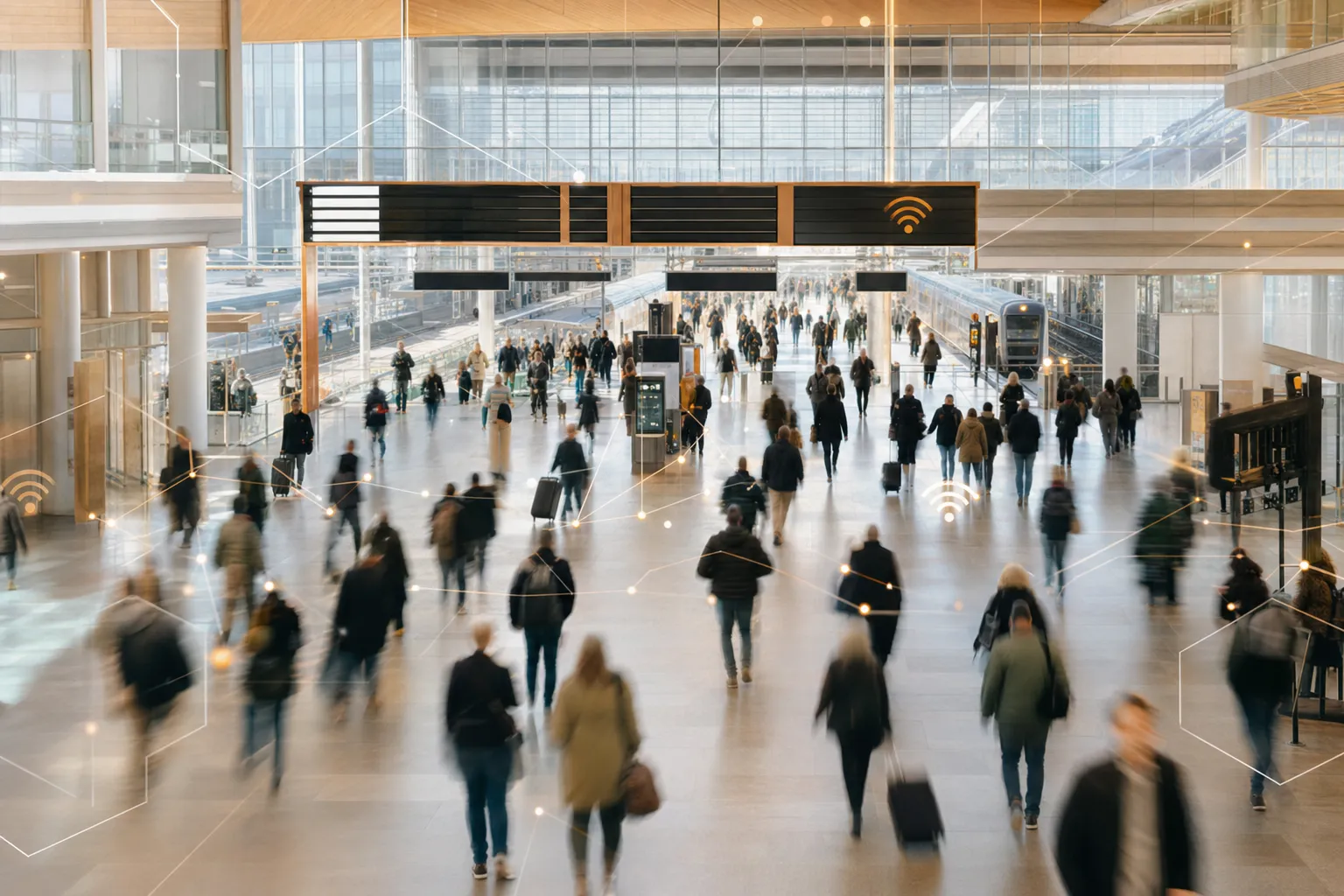
In 2020, venues across every sector had the same urgent problem: they needed to know, right now, how many people were inside. Not roughly, not by counting tickets, but accurately enough to defend a legally required capacity limit. People-counting hardware that had spent years as a nice-to-have became infrastructure almost overnight.
By the time the capacity requirements wound down, something unexpected had happened. Operators who installed live occupancy systems to survive a compliance requirement had started doing other things with the data. Staffing more sensibly. Understanding when and where the building felt too crowded before a complaint landed. Finding out which entrances were bottlenecking and which café corner sat empty through the lunch rush. The crisis tool had become an operational one.
What real-time occupancy monitoring actually does
The mechanics are straightforward. Entry and exit sensors (overhead 3D people counters, AI camera occupancy monitoring, or in larger and more dispersed settings, Wi-Fi-based systems) register each person entering or leaving a defined zone. The system maintains a running count: current occupancy equals cumulative entries minus cumulative exits.
That count can be displayed on a dashboard, used to trigger alerts when thresholds are crossed, or fed into a broader analytics stack. At the door, it can power a live indicator, a simple green/amber/red signal that tells visitors at a glance whether the venue is quiet, busy, or at capacity. In a control room, it feeds a real-time map of occupancy across the whole site.
At the entrances where the count has to be exact, Xovis 3D sensors deliver live occupancy from precisely this entry-minus-exit arithmetic.
The output is entirely aggregated. The system knows that Zone B has 47 people in it; it does not know who any of them are. That distinction matters both operationally and from a data protection standpoint.
Capacity limits were a forcing function
Before 2020, live occupancy monitoring existed mostly in environments where capacity really mattered: arenas, concert venues, stadia, some transport hubs. Elsewhere, it was a minority tool. The pandemic-era requirement to enforce hard caps pushed adoption into retail, museums, libraries, public-sector buildings, and anywhere else where indoor gatherings were restricted.
Venue operators who had not previously thought carefully about occupancy had to instrument their spaces quickly. The technology available was, in most cases, already mature, the urgency created the market, not new invention. What changed was the speed of adoption and the breadth of sectors now running live counts.
From compliance to comfort
The more interesting shift came after the restrictions ended. A meaningful number of operators kept their systems, not because they still needed to hit a legal maximum, but because they had discovered something: knowing live occupancy changes how you run a building.
Crowd density is one of the most reliable drivers of visitor satisfaction, and dissatisfaction.
Crowding and poor visitor flow consistently rank among the top complaints at attractions, malls, and transport hubs.
A visitor who arrives at a shopping centre and finds it unexpectedly packed at a Saturday lunchtime does not necessarily leave, but their experience of the whole visit is coloured by it. The same mall, perceived as well-managed and not overly crowded, generates higher dwell times and higher return intent.
Live occupancy data lets operators act on density before it crosses from busy into uncomfortable.
An alert at 80% of a comfortable-density threshold is more useful than a complaint at 110% of it.
How venues are using it now
The use cases that have stuck fall into a few categories.
Proactive crowd management. Arena and event venues use zone-level occupancy to redistribute crowds before pressure builds at a specific point, a concourse, a gate, a bar queue. Staff are redirected before the problem peaks rather than after it is visible to guests.
Visitor experience at transport hubs. Transport terminals (airports, rail stations, ferry ports) have always had hard operational constraints on flow. Live occupancy data has moved from being a security and safety tool to an experience tool: the data informs dynamic wayfinding, tells operators when a security lane or check-in desk is building up, and powers passenger-information displays that give travellers an accurate picture of the building as it is, not as it was an hour ago. Catching that build-up early matters because, once a line passes a few minutes, people abandon the queue and rarely return.
Staffing in real time. Knowing that a zone currently has higher-than-usual occupancy (because a promotion is running, because it is raining outside, because a school group arrived) tells floor managers where to direct available staff. That response is based on evidence, not intuition.
Capacity display for visitors. Some venues publish live occupancy status on displays at the entrance or on their website. This lets visitors time their arrival, reduces bunching at peak periods, and signals that the operator takes crowd comfort seriously. A public venue that tells you it is currently at 60% capacity and quieter in an hour is doing something most venues still don’t.
Historical planning. The live data accumulates into a record. Over months, operators build an accurate picture of how occupancy varies by hour, day, week, and season, across every zone they monitor. That record is what makes staffing decisions, opening-hour choices, and event scheduling defensible rather than habitual.
Dwell and density together
One layer that live occupancy data alone does not answer is how long people are staying. Dwell time and live headcount together answer both questions. Occupancy at any moment is a product of how many people are arriving and how long each of them stays. A space that is persistently high in occupancy might be receiving heavy traffic, or it might be that visitors are spending a long time there. Those are different problems with different solutions.
Combining live headcount with dwell-time analysis, something that path-level data enables, gives operators both dimensions. A zone with high occupancy and long dwell may be a popular destination that needs more capacity. A zone with high occupancy and short dwell may be a bottleneck that is slowing people through.
The same number tells a different story depending on what is underneath it.
Privacy in live counting
The privacy question comes up regularly, particularly for camera-based systems. The honest answer is that it depends on what the system actually does with the images.
A camera that processes video locally to count entries and exits, and retains only the count (never the image, never any biometric data, never any individual identifier) is categorically different from a surveillance camera. The output of the former is “23 people are in this zone”; the output of the latter is a recording of who was there. Only the count qualifies as a people-counting system in the proper sense.
Bumbee’s approach is anonymous, aggregated statistics throughout: no individual is tracked, no image is retained, no name or device identifier is linked to a movement. That is what it means to be the only footfall method in Europe approved by a data protection authority, and the standard against which any live occupancy system should be evaluated.
What you get is accurate crowd intelligence, zone by zone, minute by minute, with nothing about any individual attached to it. For the operators who discovered this during a difficult few years and chose to keep it running, that turns out to be quite enough to change how they run a building.
Frequently asked questions
What is real-time occupancy monitoring?
Real-time occupancy monitoring uses people counters (cameras, 3D sensors, or Wi-Fi-based systems) to track the number of visitors currently inside a space. Entries and exits are counted and aggregated continuously, so operators have a live figure for current occupancy rather than an estimate based on footfall totals or staff headcounts. The figure is anonymous and aggregated; no individual is identified.
How did real-time occupancy monitoring become mainstream?
Capacity restrictions introduced during 2020–2021 required many venues (retail stores, public buildings, transport hubs, entertainment venues) to enforce hard limits on the number of people inside at any time. That drove rapid adoption of electronic counting systems. When restrictions lifted, many operators kept the systems in place: the data was useful beyond compliance, for staffing, experience design, and crowd comfort.
What is crowd comfort and why does it matter?
Crowd comfort is a broad term for the visitor experience dimension that is affected by how busy a space feels, density, congestion, dwell conditions, and perceived crowding. Research on visitor experience consistently finds that crowding and poor visitor-flow management are among the top complaints at attractions, malls, and transport hubs. Live occupancy data lets operators intervene before density crosses from busy into uncomfortable.
Is real-time occupancy monitoring GDPR-compliant?
It can be, depending on the technology and how data is handled. Camera-based people counters that process images only to count entries and exits (without storing footage, recognising faces, or tracking individuals) do not process personal data in a legally meaningful sense when the aggregated count is all that is retained. Bumbee's approach uses anonymous, aggregated statistics: the system tells you how many people are in a zone, not who they are.