
Bottlenecks and pinch points: reading a crowd before it becomes a problem
Crowd congestion follows the same physics whether you are managing a transit concourse, a departure hall or a festival arena. The trick is knowing what to measure, and when to act.
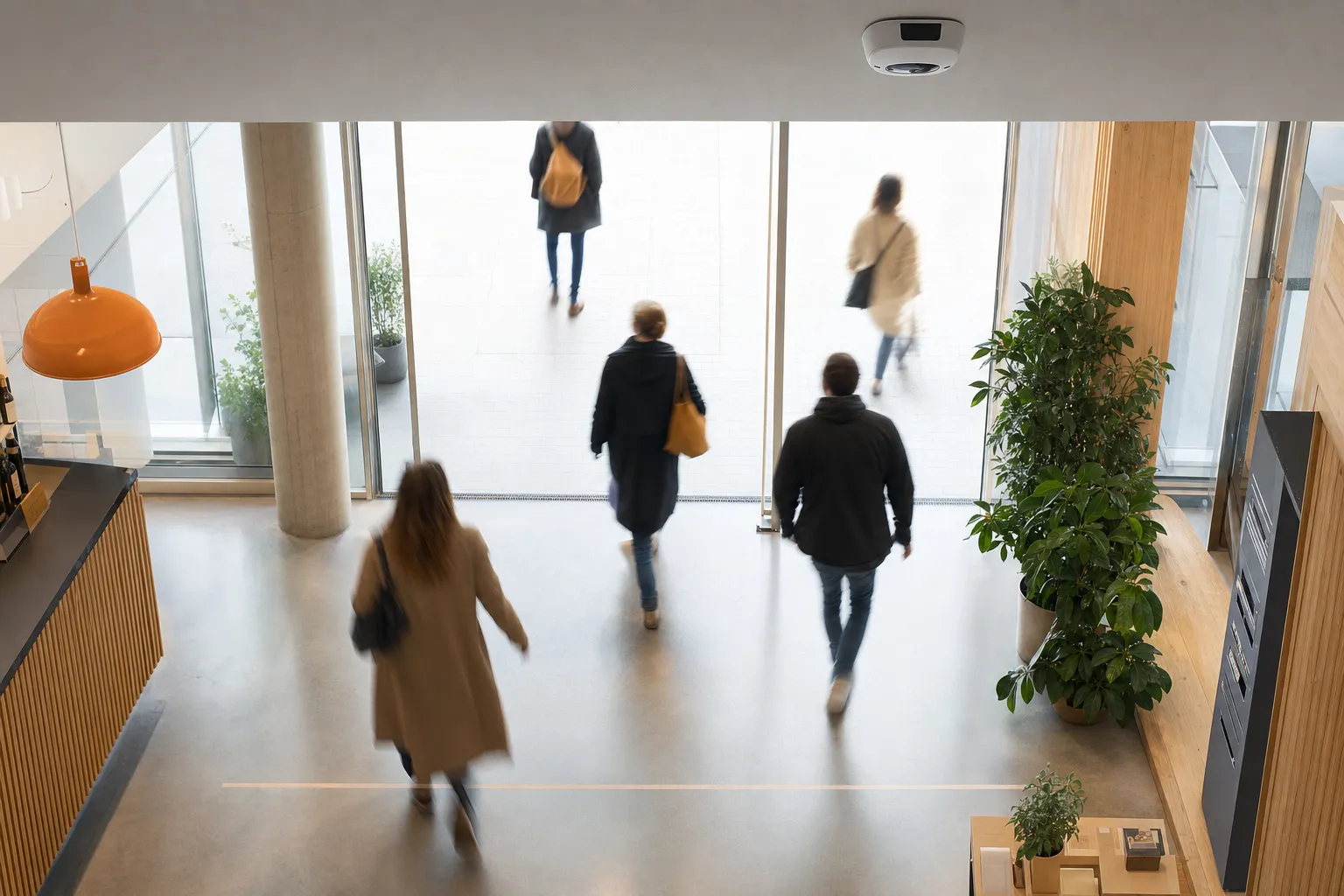
The crowd that took twenty minutes to clear the platform was fine ten minutes earlier. Nobody panicked, nothing changed in the schedule, and yet a perfectly manageable group of commuters became a slow, uncomfortable press of people blocking two exits. This is the defining feature of crowd bottlenecks: they feel sudden, but they are not.
Flow, density and the point where more means less
Pedestrian dynamics follows a relationship that feels backwards until you understand it. Up to a moderate density, adding more people to a corridor or concourse increases total flow: the space is being used more efficiently. Past a threshold, the opposite happens. Individuals slow down to avoid contact, lanes begin to interfere with one another, and overall throughput falls even as the crowd grows larger. In extreme cases (a crowd at a festival gate, a stadium exit) the system can stall almost completely.
The relationship between density and flow is well established in the pedestrian engineering literature and forms the basis of how architects design evacuation routes, how transport operators size concourses, and how event planners calculate time-to-clear. Understanding it is the first step; measuring it in your specific space is the second.
The group problem most operators miss
There is a structural complication that pure headcount misses. Most people in a crowd are not walking alone.
A 2010 study by Moussaïd, Perozo, Garnier, Helbing and Theraulaz, published in PLoS ONE, found that up to 70% of pedestrians in a public space are moving in social groups, couples, families, colleagues, small parties.
Those groups behave differently from solo walkers.
At low density, groups walk side by side, forming a line across the walkway. That configuration is sociable and comfortable, but it occupies width. As density rises, the same group compresses into a V-like formation: one person leads, others fall slightly behind. The V uses less horizontal space but creates a longer effective footprint in the direction of travel. The net effect is that a corridor filled with group pedestrians reaches its functional capacity earlier than a simple headcount would predict.
For transport hubs and airports (where gate changes, delays and platform announcements can shift large family groups suddenly) this matters enormously. A pinch point that handles a Tuesday commuter flow without complaint can fail completely on a Saturday when the same corridor is full of groups pulling luggage.
Where pinch points form
Pinch points are not random. They cluster around a predictable set of features:
- Transitions between wide and narrow space, a concourse that funnels into a single-door barrier, or an open plaza that narrows to a pedestrian bridge.
- Directional conflicts, junctions where two flows cross or merge, producing the pedestrian equivalent of an uncontrolled intersection.
- Uneven service speeds, ticket barriers, security lanes and boarding queues that drain at different rates, creating pooling upstream of the slowest point. Where the slow point is a checkout or a service desk, the pooling is also a commercial problem: shoppers abandon a queue and rarely come back.
- Attraction points, information screens, departure boards, food stalls, or any feature that causes people to stop or slow in the middle of a flow.
The last category is the most commonly underestimated.
A well-placed departure screen that causes thirty people to pause and read in a corridor that was otherwise flowing smoothly can trigger a queue stretching back fifty metres.
Reading the early signals
An experienced operator can often spot an emerging bottleneck before it becomes a problem, the posture of a queue, the pace of people arriving versus leaving a junction. The difficulty is scale. A single trained observer cannot simultaneously watch six concourse junctions, four security lanes and two platform exits.
Continuous anonymous sensor data changes this. When arrival and departure counts are logged at each key point, the maths does the watching, and a live occupancy figure for each zone turns that watching into a number an operator can act on. A count that shows consistently more people entering a junction segment than leaving it is an early signal of accumulation. The gap between arrival rate and departure rate, measured over minutes rather than inspected at a glance, gives operators time to act: open an additional gate, post a marshal to redirect flow, push a real-time message to a public screen.
Arena and stadium operators have been the earliest adopters of this approach, partly because the stakes at egress are highest and partly because event timings make peak flows predictable and therefore plannable. The same logic applies to airports with departure waves, or train stations with rush-hour patterns that vary day to day but are consistent enough to model.
Hybrid sensing for complex venues
No single sensor type covers every scenario. A busy airport terminal combines long, open spaces where Wi-Fi or cellular analytics provides excellent aggregate flow data, narrow doorways and corridors where 3D depth-sensor counters give high-resolution per-minute accuracy, and outdoor forecourts where camera-based or cellular methods are more appropriate.
Hybrid people-counting solutions layer these methods so each part of the venue is measured by the technology best suited to it, and the outputs are unified into a single operational picture. The goal is not a technically impressive dashboard, it is an operator who can see, at 08:47 on a Monday morning, that the northern security lane is accumulating faster than the southern one and can act before the queue reaches the lifts.
Early alerts and the privacy question
The operational case for crowd monitoring is easy to make. The civil liberties question deserves a straight answer, not a footnote.
Counting how many people are moving through a junction, or how dense a zone has become, does not require identifying anyone. The data that feeds a crowd-flow alert (how many signals, how many sensor breaks, what cellular density) is anonymous and aggregated before it reaches any operator screen. Nobody’s journey is logged. No face is matched to a database.
This distinction matters more as public-space sensing becomes more common. The information that helps an airport or a transport operator manage a pinch point safely is crowd-level data, not individual surveillance. Those are different things, and the technology is capable of delivering the former without the latter.
Acting before the queue reaches the lifts
The crowd that blocked those platform exits did not materialise from nowhere. The conditions that produced it (a narrow exit, a higher-than-usual arrival rate, a group-heavy passenger mix on a Saturday) were measurable in advance. The bottleneck was predictable; what was missing was the measurement.
Continuous, anonymous flow monitoring turns a known structural risk into an observable, manageable variable. That is crowd management reduced to its practical core: not eliminating crowds, but knowing where pressure is building before it reaches the people in it.
See how this applies at scale: arena crowd flow analytics and hybrid people-counting solutions cover the sensing layer; visitor analytics for transport hubs covers the operational picture.
The pinch point does not disappear, but you stop being surprised by it.
- 70%
- Pedestrians moving in social groups
Frequently asked questions
What causes bottlenecks in public spaces?
Bottlenecks form when the flow of people arriving at a point exceeds the capacity to pass through it. Common triggers are narrow doorways, directional conflicts at junctions, uneven service speeds at counters, and the natural tendency of pedestrian groups to walk side by side. Once density crosses a threshold, throughput actually drops even if more people are trying to get through.
How does crowd density affect pedestrian flow?
At low density people walk freely and at their chosen pace. As density rises, pedestrian dynamics research shows that individuals begin to adjust speed and direction to avoid contact, lanes of unidirectional flow emerge spontaneously, and group formations compress. Above a critical density, the crowd can slow to a near-standstill, a counterintuitive collapse where adding more people reduces total throughput.
Can footfall data detect a bottleneck before it becomes dangerous?
Yes. Continuous anonymous counting at key points in a venue generates real-time flow data that can be compared against historic baselines. A sustained divergence, more people arriving at a junction than leaving it, is an early signal. Operators can act on that signal well before conditions deteriorate, redirecting visitors, opening additional gates, or adjusting signage.
How does privacy-compliant monitoring work in crowded public spaces?
Anonymised, aggregated counting does not require cameras pointed at faces or systems that identify individuals. Wi-Fi sensing, 3D depth sensors and cellular analytics all produce crowd-level statistics (densities, flow rates, dwell times) without attaching data to any person. The output is a map of movement, not a record of who moved.