
The forecourt funnel
Fuel brings drivers onto the site. The shop is where the money is. Most operators have only a rough idea how many people make the walk from pump to door, and a much rougher idea why the rest don't.
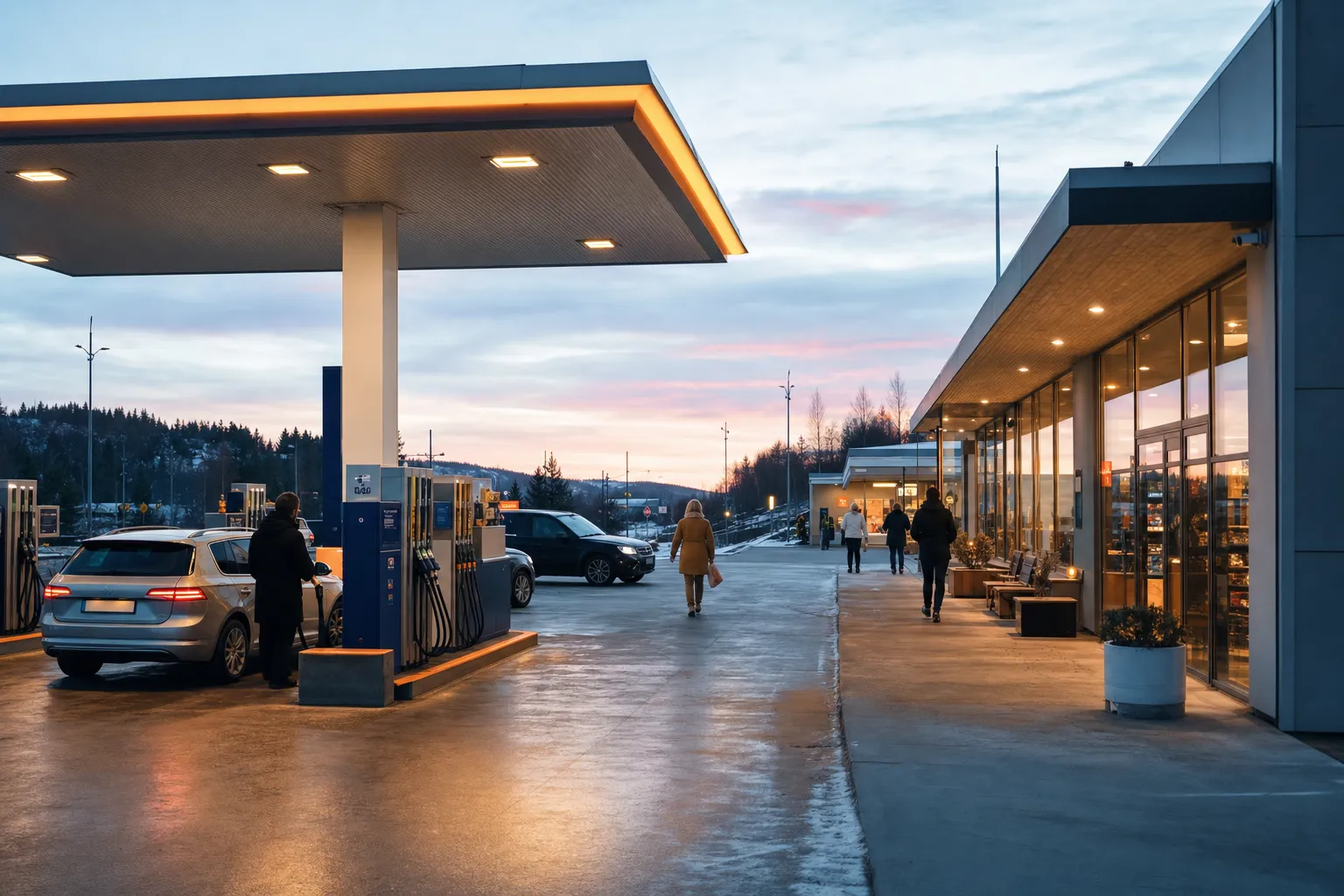
Every fuel customer is already on your site. They have stopped the car, their wallet is out, and they are standing less than twenty metres from the shop door. The conversion opportunity does not get warmer than this. On most forecourts, the majority of them get back in the car without ever going inside.
Understanding why, and measuring the rate precisely, is one of the most direct profit levers available to a forecourt or convenience retail operator.
The margin is not in the fuel
Fuel gross margins run at roughly 8–10% of pump price, according to industry analysis from sources including Toast and Paytronix. After rent, staff, and equipment, net profitability on fuel alone is negligible, often well under 2%. Fuel is a traffic driver: a reliable reason to stop, not a profit centre.
The shop is where the economics change. Prepared food and beverages, the highest-turning lines in a good forecourt shop, carry margins that dwarf anything achievable at the pump. Industry analysis suggests that in-store sales, typically around 30% of a combined site’s revenue, can account for 70% of total profitability.
The pump-to-store journey is the margin model.
What the pump-to-store conversion rate actually looks like
The headline figure that circulates in convenience retail trade press is not encouraging. US industry data, cited by consultants including Agilence and by Convenience Store News, suggests that on a typical fuel-selling c-store site, somewhere between 27% and 35% of fuel customers enter the shop, a capture rate that leaves the majority of forecourt visitors uncaptured.
One framing: roughly two in three drivers who stop for fuel leave without going inside.
Site format and offer matter significantly. Research from South African operators published by Bizcommunity found that BP sites hosting a Pick n Pay convenience store achieved a 8.1% overall conversion rate, compared to 4.9% for unbranded BP sites; Engen sites with a Woolworths food offer reached 9%, compared to 5.3% for comparable sites without the branded partner. The branded food or retail presence lifts conversion, but even the best-performing sites still leave the majority of forecourt visitors uncaptured.
For a multi-site operator running dozens or hundreds of locations, even a percentage-point shift in conversion across the estate is a material commercial outcome.
What drives the walk to the door
Promotional visibility is consistently one of the strongest factors.
GSTV research, reported by CSP Daily News, found that around 40% of shoppers who had not planned to go inside could be persuaded to do so by an advertisement at the pump.
Many conversion decisions are made at the pump, not inside the shop, which makes what customers can see from the forecourt as important as the shop’s internal layout.
Food and drink offer is another strong driver. Sites with a credible foodservice offer (a coffee machine customers trust, a hot food counter with recognisable brands) show better conversion rates than sites where the shop is primarily ambient packaged goods. The journey from pump to door needs a reason; a cup of coffee is a better reason than a can of motor oil.
Speed matters too. A customer expecting a slow visit, long queue, unclear layout, thin staffing, is less likely to attempt it on a time-constrained fuel stop. Visitor analytics for petrol stations and convenience retail includes queue detection and dwell time by zone, showing operators when and where the shop experience is suppressing conversion before it registers on the till.
The measurement problem
Most operators lack a precise, continuous conversion rate. They have till receipts, how many transactions happened inside. They may have approximate forecourt entry counts from a loop detector. What they typically do not have is a clean daily figure showing how many people were on the forecourt versus how many entered the shop, broken down by hour, day of week, or site.
Decisions about staffing, promotional investment, and shop layout end up being made on sales trends rather than footfall behaviour. Sales rise after a coffee machine is installed; but without knowing whether shop entries increased or whether existing shoppers just spent more, attributing causation is guesswork, and predicting what would happen at a different site is impossible.
Gas station chain analytics requires both numbers. Forecourt arrivals, measured at the site perimeter, and shop entries, measured at the shop door, together produce a conversion rate trackable over time and comparable across sites. The data deliverables from continuous footfall monitoring include hourly and daily counts at each measurement point; the conversion rate is a derived metric from those two streams.
Where the funnel leaks
There are several places in the forecourt-to-store journey where a potential customer disengages.
Some make the decision at the pump: they are in a hurry, the weather is poor, or nothing they saw gave them a reason to move. Some start walking and divert to the car wash or the air machine. Some enter the shop but leave without buying, the in-store conversion rate from entry to transaction is a separate funnel stage with its own dynamics. And some simply never intended to go inside, regardless of what the site offers.
Footfall data can identify where in the journey the volume is being lost, not just that it is being lost. A site where forecourt arrivals are high but shop entries are low has a different problem from one where shop entries are reasonable but dwell time and transaction rate are low. The interventions are different; so is the priority.
Measuring the rate, not estimating it
The forecourt funnel is a ratio, arrivals on site to entries into the shop, and it is measurable continuously. Wi-Fi-based people counting at the shop entrance, combined with forecourt sensor data, produces that ratio without cameras pointed at customers and without adding operational complexity to staff already managing a busy site.
The measurement is anonymous throughout. What the system produces is counts: how many people were on the forecourt each hour, how many entered the shop, what the resulting conversion rate was. No individual tracked, no behaviour attributed to a named person. The in-store conversion rate from entry to transaction is a separate funnel stage, but it starts here, at the pump-to-door number that most operators currently estimate. GDPR-compliant footfall analytics makes it measurable. The funnel is measured. The drivers and their decisions remain their own.
- 8–10%
- Fuel gross margin on pump price
- 70%
- Share of profitability from in-store sales
- 27% and 35%
- Fuel customers who enter the shop
- 40%
- Uninterested shoppers persuadable by a pump ad
Frequently asked questions
What is a typical forecourt-to-store conversion rate?
Industry figures suggest that somewhere between a quarter and a third of fuel customers enter the convenience store on the same visit. The range is wide because it varies significantly by site format, location, offer quality, and whether a branded food or retail partner is present. The only way to know your site's actual rate is to measure it.
Why does it matter whether a fuel customer enters the shop?
Fuel margins are thin, typically well below 10% gross on pump price. In-store products, particularly prepared food and beverages, carry margins many times higher. Industry analysis consistently shows that convenience store sales represent a disproportionate share of total site profitability. Converting a fuel visit into a shop visit is the highest-leverage action available to a site operator.
How can a forecourt operator measure pump-to-store conversion?
The conversion rate is the ratio of shop entries to forecourt arrivals. Both numbers need to be counted separately and accurately: total vehicles or people on the forecourt, and total people entering the store. Footfall sensors at the forecourt perimeter and at the shop entrance make this calculation continuous and auditable, rather than estimated from till receipts.
What interventions improve shop entry rates from the forecourt?
Promotional visibility at the pump is consistently one of the strongest levers. GSTV research presented at the 2024 Sweets & Snacks Expo found that around 40% of shoppers who had not intended to go inside could be persuaded to do so by advertising at the pump. Branded food partnerships also reliably lift conversion. The challenge is isolating which interventions work at your site, which requires measuring the conversion rate before, during, and after any change.